
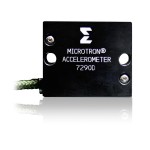
Accelerometer Adds IEEE 1451.4 TEDS Capabilities
December 31, 2010 by Randy Frank
Filed under Accelerometer, Featured, Vibration
The IEEE 1451.4 Transducer Electronic Data Sheet (TEDS) established common templates and descriptive language for plug and play sensors. Analog sensors with the self-identification have a paper-less method of managing sensor and calibration information. Meggitt Sensing Systems Endevco model 7290D series is one of latest to incorporate the capability.
The 7290D series employs a variable capacitance element with gas damping and internal over-range stops, allowing the sensor to survive significant shock and acceleration loads of up to 10,000 g, with 2.5% total dynamic accuracy. Units feature excellent non-linearity, including hysteresis, of typically 0.2% for ranges of 2 g to 50 g. Offered in five different models with available measurement ranges from 2 g to 100 g, the TEDS capability allows the 7290D series to be used within larger channel count instrumentation applications.
For more information on the 7290D series with TEDS, click here.
Monitor Gas Pipeline Vibration with 4-20 mA Transmitters
December 31, 2010 by Randy Frank
Filed under Accelerometer, Featured, Vibration
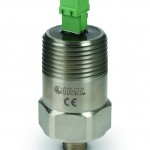
Monitoring machinery health is common in many industrial applications to reduce downtown and avoid catastrophic failures. When a hazardous environment such as a gas pipeline is involved, special packaging is required. IMI Sensors newest Series 640 (hazardous area-approved versions) transmitters are manufactured to meet specific natural gas industry design requirements, including certification in accordance with ATEX and CSA for use in hazardous areas.
The two-wire, loop-powered 4-20 mA vibration sensors are enclosed in welded, hermetically sealed, stainless steel housings. With power from a 12-30 Vdc source, the 4-20 mA output can be connected to existing PLC, DCS, and SCADA systems.
For more information on the hazardous area-approved versions of IMI Sensors’ Series 640 industrial vibration transmitters, click here.
Measure Industrial Differential Line Pressures up to 2,000 PSI
December 30, 2010 by Randy Frank
Filed under Featured, MEMS Sensor Technology, Pressure
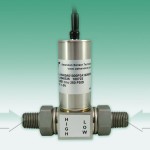
It’s amazing how much information a sensor’s package conveys regarding its application. American Sensor Technologies, Inc. (AST) AST5400 screams industrial, high pressure. In fact, the wet / wet differential pressure sensor can measure line pressures up to 2,000 PSI. With microelectromechanical system (MEMS) technology as the sensing mechanism, the package uses Krystal Bond Technology to avoid silicone oil, O-rings or welds.
To measure differential pressure across a filter, monitor level in a sealed or vented tank, or calculate flow across an orifice plate, the sensor has turndown ratio of 15 to 1 and can be used in place of two gauge pressure sensors.
For more information the AST5400, click here.
Sense Differential Pressure over a Wide Range in Medical Ventilation Applications
December 28, 2010 by Randy Frank
Filed under Featured, Pressure
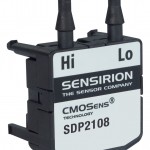
While many medical ventilation measurements are easily handled by a 0 to 500 Pa differential pressure sensor, some require a wider dynamic range. For these applications, Sensirion introduced the SDP2108-R sensor. Based on its SDP1108-R that covers a measurement range of 0 to 500 Pa, the SDP2108-R addresses a range of 0 to 3500 Pa.The fully calibrated and temperature compensated sensor has an analog output signal with a range of 0-4 V and a response time of 8 ms. While designed specifically for patient ventilation measurements, the differential pressure sensor can also handle process automation and HVAC control systems applications.
For more information on the Sensirion SDP2108-R differential pressure sensor, click here.
Acquire Motion Control and Position Sensing Data with Serial Synchronous Interface Module
December 27, 2010 by Randy Frank
Filed under Featured, Signal Conditioning
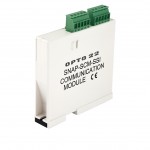
Opto 22’s SNAP-SCM-SSI Serial Module provides a communications interface between digital encoders and its SNAP PAC System I/O processors or programmable automation controllers. The module’s two isolated serial synchronous inputs (SSI) simplify acquiring data from optical and mechanical encoders and other types of linear and rotary transducers.
Accommodating an SSI clock frequency of up to 2.5 MHz, the module functions at cable lengths up to 500 feet, and can be configured for clock frequency, data bits (i.e., encoder resolution), time interval between data samples, and more. The module accepts input from either binary or Gray code encoders to process and communicate position-related data for several industrial applications.
For more information on the Opto 22 SNAP-SCM-SSI module, click here.
Legislating More Sensors
December 26, 2010 by Randy Frank
Filed under Featured, Image, Vision
If the National Highway Traffic Safety Administration (NHTSA) gets its way, backup cameras will be required on all new vehicles by 2014. Intended to prevent drivers from backing over pedestrians, the Rule could add the cost of camera and display electronics to low-end cars, the most cost-sensitive vehicles. NHTSA data indicates an average of 292 people die each year from back-over accidents. The victims are primarily children and the elderly. In addition to the fatalities, over 18,000 injuries occur per year.
CMOS image sensors are commonly used in high-end and high-feature content vehicles. For vehicles with a display screen for navigation and/or driver information, the cost may be in the $88 to 158 range. However, for other vehicles, the backup camera system could add $159 to $203 to the vehicle’s cost. Traditional automotive camera suppliers, such as Sanyo, stand to benefit from the proposed legislation.
For more information on the proposed NHTSA Rule, click here.
For more information on Sanyo’s backup camera, click here.
Monitor Energy Consumption to Save Energy
December 21, 2010 by Randy Frank
Filed under Frank Talk
A MEMS Update from Roger Grace
December 6, 2010 by Randy Frank
Filed under Frank Talk, MEMS Sensor Technology