

I am always impressed when existing technology is applied to a problem in a new and unique way. That is what Hövding, a Swedish design house has done with motion sensors and microcontrollers from STMicroelectronics. In spite of the fact that bicycle helmets reduce injuries by at least 60%, many cyclists do not use them. Existing designs […]
motion sensing
Motion Processing IP Cores for Sensing Applications

With the combined market for MEMS accelerometers, gyroscopes, magnetometers and pressure sensors in mobile devices predicted to exceed 4 billion units by 2015, Movea, a motion-processing and data fusion technology company, has a solution for higher performance and lower power consumption. The company’s MotionCore product line is a family of motion processing IP Cores designed […]
Nine-Axis MEMS Motion Sensing
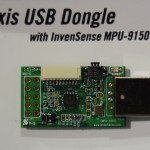
At the 2012 International CES (Consumer Electronics Show) in Las Vegas, David Borison of InvenSense demonstrates the capabilities of nine-axis motion sensing using the company’s newly introduced MPU-9150 nine-axis (gyro + accelerometer + compass) MEMS MotionTracking device. The multi-axis sensor incorporates MotionFusion and run-time firmware that simplifies motion sensing in end products. To further simply […]
Three-axis Gyroscope Offers Small Size and Low Power
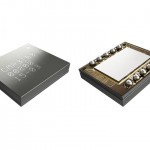
At the 2012 International CES (Consumer Electronics Show) in Las Vegas, Juha Lahtinen of VTI Technologies demonstrates the capabilities of the company’s newest three-axis, low power (2.5 mA) gyroscope, the CMR3100, as well as sensor fusion capabilities. VTI’s Sensor Fusion is a 9-axis 6 DOF solution for Android devices. To watch the video, click here. […]
Sensing in an Armband Health Monitor
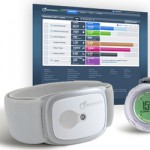
Nick Wilson of BodyMedia discusses the sensing and capabilities of the company’s two health monitoring devices at the 2012 International CES (Consumer Electronics Show) in Las Vegas. To watch the video, click here. For more information about BodyMedia FIT Armbands, click here.
Sensors Enable Portable Healthcare Innovations
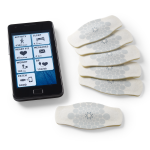
Sensors as well as communication ICs and microcontrollers provide the enabling technologies for several new innovations in healthcare. A Kalorama Information Dec. 1, 2010 report estimates that the global market for medical mobile apps hit $84.M in 2010, increasing more than 2X its 2009 level of $41M. This is just the downloadable software portion of […]
Track Calories Burned and More with Body Monitoring System
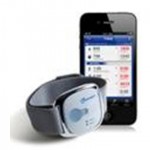
BodyMedia FIT Armband BW, a wearable body monitoring system, uses four sensors to track thousands of data readings and display them to show users their calories burned, steps taken, physical activity and sleep duration and efficiency. Using Bluetooth wireless technology, the results can be sent to an app on the user’s smartphone (iPhone or Android) for […]
Motion Sensing Demoed in Visteon Concept Vehicle

The center console (dashboard) could change dramatically in future vehicles with controls located closer to driver. This frees up space for other options. Visteon demonstrates one possibility using motion sensing to Sensor Tips senior editor Randy Frank at CES 2011. To view the video, click here. To find out more about instrument panel technologies from […]
Highly Integrated MEMS-Based Motion Sensing
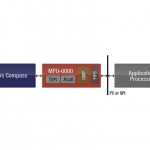
Motion sensing is at the heart of several new features in consumer products including cell phone, tablet PCs and games. InvenSense has been a major player in these applications but its newest product family makes motion sensing even easier to design and manufacturer. MPU-6000 product family integrates a 3-axis gyroscope and a 3-axis accelerometer on […]
Software Simplifies Motion Sensing
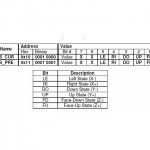
Motion sensing is one of the hottest sensing areas. Using microelectromechanical systems (MEMS)-based accelerometers and gyroscopes, systems designers are adding motion sensing to smart phones and other handheld products, as well as games, movies and even medical applications. To simplify the use of its MEMS sensors, Kionix has developed a software engine called Gesture Designer. […]
