
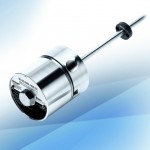
Micronor launches Model MR330 fiber-optic position sensor
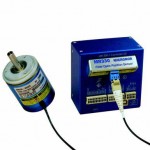
Micronor (www.micronor.com) has unveiled the first commercially offered fiber-optic position sensor suitable for long-distance position sensing without being affected by ground loop issues — the Model MR330 fiber-optic position sensor. Its optical design provides immunity to all electro-magnetic interference such as radiation, magnetic fields, lightning and other extreme conditions.
Without any electronic component, the position sensor can measure absolute angular position more than zero to 360 degrees with speeds exceeding 2,500 rpm and 13-bit (8192-count) resolution. An optical technique integrated in an active controller and a passive sensor, held together by a 62.5/125 multimode duplex fiber-optic link allows the position sensor to track multiple turns to 12-bits (4096-revolutions). Powered by 24 VDC, the optical sensor’s controller sends a burst of light to the sensor’s code disk that modulates the light’s spectral components based on angular position. The position data is embedded in the light’s optical spectrum and led back to the controller for accurate position readout.
“The uniqueness of the system is that the sensor is entirely passive, meaning that there are no electronic components whatsoever in the unit,” said Robert Rickenbach, Chief Engineer at Micronor.
“The result is that the sensor can be directly deployed in extreme environments where conventional electronic-based encoders have distinct limitations.”
The accuracy and EMI immunity of MR330 make it ideal for application requiring for precise position measurement and motion control in challenging environments, such as satellite antennas, oil rigs, actuator systems, solar panel arrays, steel mills, transportation systems and medical instrumentation. The optical sensors also conform to the ATEX requirements, making it suitable for use in mines and other explosive environments. Its immunity to lighting makes it ideal for various outdoor applications including antennas and wind turbines.
LVDT Position Sensors Target Elevators
November 25, 2010 by Randy Frank
Filed under Featured, Position
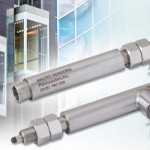
In elevator applications, Macro Sensors Spring Loaded LVDT position sensors measure the spring deflection as a result of the load. The sensors’ springs compress as an elevator is loaded with passengers to ensure that both cars and building floors properly align for each floor. Depending upon the elevator manufacturer, sensors are mounted either under or above the elevator car.
The hermetically-sealed s (IEC IP-68) sensors are designed and manufactured for rugged applications enabling them to survive heavy shocks as well as the effects of dirt, water, steam and other corrosive elements without effecting performance. They are offered in stroke ranges of ±0.050” to ±-2.0” (±1.25 mm to ±50 mm) in both AC and DC input/output configurations.
For more information on Macro Sensors Spring Loaded LVDT position sensors, click here.
Honeywell Extends SMART Position Sensor to 225 mm
October 25, 2010 by Randy Frank
Filed under Featured, Position
Adding to its SMART Position Sensor 75 mm Linear Configuration, Honeywell’s SMART Position Sensor 225 mm Linear Configuration’s simple, non-contact design eliminates mechanical failure mechanisms, reduces wear and tear, improves reliability and durability, enhances operational efficiency and safety, and minimizes downtime. Also, the adaptable, non-contacting design allows customers to eliminate unnecessary connections for installation, reducing installation time and components
The sensors two output options include analog or digital for use in control systems requiring an RS232-type interface with a 57.6 kbits/s baud rate. The device accurately measures values down to 0.14 mm [0.0055 in] analog and 0.0035 mm [0.000137 in] digital.
For more information about Honeywell’s SMART Position Sensor 225 mm Linear Configuration, click here.
Macro Sensors Unveils New Web Site
April 27, 2010 by admin
Filed under Industry News, Position
Pennsauken, NJ - Sensor manufacturer Macro Sensors (www.macrosensors.com) has redesigned its web site to make it easier for design engineers to find LVDT linear position sensors and RVDT rotary position sensors that meet the performance criteria of applications in specific industries.
Finding that many web visitors were unsure of what type of sensor that might meet their application requirements, Macro Sensor wanted to simplify sensor selection by visually grouping its LVDT and RVDT position sensors by target markets. Now, Macro Sensors’ web site segments LVDT and RVDT position sensors into application categories, grouping those that best operate in conditions prevalent in:
- Energy/Power Gen
- Factory Automation
- Aerospace/Military
- Hydraulics/Pneumatics
- Industrial OEM
- Civil Engineering/R&D
- Sub Sea/Marine
- Transportation
In addition to providing detailed product specifications and drawings on every product, Macro Sensors’ web site also features application stories and press releases that explain how different linear and rotary position sensors are implemented in specific industrial and military applications. For more information on Macro Sensors product line of LVDT based linear position sensors and RVDT based rotary position sensors, go to the web site at www.macrosensors.com or contact the factory at positionsensors@macrosensors.com.
Macro Sensors
www.macrosensors.com
Position Sensor Measures Without Touching Its Target
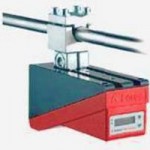
The KD-2446 high-precision proximity sensor system from Kaman Precision Products offers lead-free RoHS compliance in a compact DIN package that is simple to install. Featuring a 10 KHz analog output and threshold-adjustable 3.3 KHz switched output, the KD-2446 is a flexible solution for hight speed automated manufacturing and process control applications.
The KD-2446 performs with 0.0008 percent FS resolution and 0.56 percent FS switch point hysteresis. With CE and RoHS compliance, the system is appropriate for OEM applications with worldwide distribution, including displacement, vibration, sorting and event capture.
Using inductive, eddy current technology that measures without touching the target, the sensor system also offers high performance with both ferrous and non-ferrous targets. It consists of two sub-assemblies: the sensor with integral cable and the signal conditioning or electronics module. Input voltage is variable from 12 to 24 volts DC, and gain is adjustable for up to 22 volts output, with 24 volt DC input.
The Kaman KD-2446 system comes standard with one of two production sensor configurations, 9C or 5CM. Both sensors are rated for continuous operation up to 400 degrees Fahrenheit.
Dual Output Rotary Position Sensor from Penny + Giles
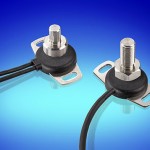
CHRISTCHURCH, UK – Penny + Giles has introduced the NRH280DP, a new dual output ‘no contact’ rotary position sensor. The NRH280DP uses proven, non-contact programmable Hall-effect technology to provide OEMs with highly reliable and accurate rotary measurement in extreme industrial and off-highway environments. This low-profile sensor, with a 6.5mm profile, one of the thinnest available, provides numerous programmable options. Designed for operation in extreme temperatures, the NRH280DP enables system designers to quickly and easily improve the safety and integrity of their control systems. The rugged NRH280DP is ideal for use in arduous operating environments and is currently used in diverse applications including articulated dump trucks (tip control), garbage collection vehicles (bin lift control), road sweeping vehicles (4-wheel steering), and Formula 1 racing cars (throttle pedal position).
Penny + Giles’ configurable NRH280DP provides OEMs with a wide selection of parameter options including measurement range, and clockwise or anticlockwise direction output. This flexibility provides OEMs with a greater amount of control to configure the sensor to best suit their needs and achieve maximum performance. For example, the sensor can be configured so that one signal can be used in a control function while the other is used for position monitoring or display purposes.
NRH280DP Performance Features:
· Dual outputs
· “No Contact” Hall-effect technology
· Supports air gap between 2-7mm
· Low-profile: 6.5mm profile
· Power requirements: 5Vdc regulated or 9-30Vdc unregulated power supply
· Over-voltage protection to 40Vdc
· User programmable with 341 different angles (0-20 to 0-360 degrees: in one degree increments)
· 12-bit resolution (0.025%) over selected angular range
· Analog (0.5 to 4.5Vdc) or digital (Pulse Width Modulated) signal outputs
· Factory programmable to 0.1 to 4.9Vdc output range
· Electromagnetic immunity to 100V/m (<1mV maximum output signal)
· ±0.4% non-linearity
· Operating temperature range: -40 to +140ºC @ 5Vdc (< ±30ppm/ºC stability)
Unlike conventional captive shaft rotary position sensors, the NRH280DP has a separate magnet assembly that activates the fully encapsulated Hall-effect sensor with a permissible air gap of between 2 and 7mm. This allows the sensor to be used in extreme environments that are subjected to high shock and vibration, or can endure high-pressure wash-downs (IP69K protected).
The sensor’s slim, low-profile housing, measuring only 6.5mm, is one of the thinnest available in the industry. Its transmissive properties between the magnet and sensor enable operation through non-magnetic materials, such as gearbox castings. The NRH280DP can operate from either a 5Vdc regulated or 9-30Vdc unregulated power supply and has over-voltage protection to 40Vdc. Each of its dual output channels can be supplied programmed with any one of 341 different angles in the range 0-20 to 0-360 degrees, in one degree increments, and features a 12-bit resolution (0.025%) over the selected angular range.
To ease configuration, NRH280DP is available with analog (0.5 to 4.5Vdc) or digital (Pulse Width Modulated) signal outputs as standard, but can also be factory programmed to offer 0.1 to 4.9Vdc output range, matching the equivalent signals from a potentiometer. Its two outputs can be used for error checking if they are set up to be opposed (clockwise on the first signal and anticlockwise on the second signal) and the output summed.
NRH280DP features electromagnetic immunity to 100V/m and it has a very low maximum output signal noise of less than 1mV. This means that no additional signal filtering is required on the output signal. It also has a class-leading non-linearity of ±0.4%. When powered with 5Vdc, the NRH280DP has an operating temperature range from -40 to +140°C, with a stability of less than ±30ppm/°C, and can also withstand temperatures up to +170°C for 72 hours.
BIM-UNR Dual Sensor For C-Groove Cylinders
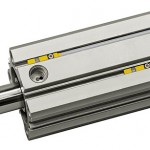
Minneapolis, MN — TURCK’s BIM-UNR line of compact magnetic cylinder position sensors now includes a dual sensor designed for detecting short and long stroke C-groove cylinders. BIM-UNR dual sensors provide a distinct advantage by combining two sensors through one cable connection to speed installation, as well as lessen wire costs and connection points. This design makes the sensor particularly beneficial in areas where multiple cylinders are used, as it only requires a single cable. With dimensions of 2.9 x 4.6 x 18 mm, BIM-UNR features one of the lowest profiles on the market.
Delivering reliable performance and high EMC immunity, TURCK’s BIM-UNR dual sensor provides an exceptional alternative to ordinary cylinder position sensors. The sensor mounts within C-groove cylinders with no accessories required. Plus, it can be inserted into a C-groove from the top rather than from the side, further simplifying installation. On the sensor’s side is a built-in tab that keeps the sensor in place to facilitate one-handed mounting. As the mounting screw is located near the cable exit, the sensor remains fastened even if the cable is pulled.
TURCK
www.turck.us
MTS Sensors Improves Linear-Position Sensor Vibration Tolerance
CARY, N.C. – MTS Systems Corp., Sensors Division has further improved the design of its Temposonics linear-position sensors to increase the sensors’ longevity in high-vibration applications like those in the wood industry. The High Vibration Resistance option (HVR) increases the vibration tolerance from 15g to 30g (10-2000 Hz) in MTS’ R-Series Analog, R-Series SSI, and G-Series sensors, and further increases the longevity of the sensors. These developments, in addition to the rugged durability of their non-contact magnetostrictive technology, make MTS’ Temposonics linear-position sensors ideal for wood industry applications including all types of sawmill machinery, plywood and veneer equipment, portable mills and tree harvesting and processing attachments.

The wood industry requires a wide range of machinery that must operate under harsh conditions while providing accurate performance. Downtime and lost productivity are expensive, and linear-position sensors are critical components in maintaining an efficient operation.
The robustness and reliability of MTS Temposonics R-Series and G-Series linear-position sensors can greatly reduce maintenance costs, and quite often, can be used to extend the life of older machines. R-Series and G-Series linear position sensors provide a cost-effective solution for applications that demand tough, low-maintenance position sensors that ensure accuracy and production efficiency.
MTS’ Temposonics linear-position sensors employ non-contact, magnetostrictive sensing technology, which, by eliminating wear, provide users with much higher durability and output reliability than other technologies such as potentiometers or optical encoders.
The changes made to MTS’ Temposonics R- and G-Series linear-position sensors are designed to increase the longevity of the sensors’ High Vibration Resistance (HVR) option, which doubles the prior vibration resistance of 15g. The improved linear-position sensors can survive impact forces of 100g and continuous vibration of up to 30g (from 10-2000 Hz), which significantly increases their longevity, especially in harsh environments and high-vibration applications.
MTS’ R-Series sensors are rugged, industrial sensors that provide absolute, linear-position measurement with high-performance output protocols. With linearity down to +/- 20 microns or better, resolution of 1 micron, and repeatability within 0.001%, these sensors are ideal for applications that require accuracy, reliability, and consistency.
G-Series sensors are rugged, industrial sensors that provide highly accurate measurements in either analog or digital outputs, offer enhanced diagnostics and programming capabilities, and are designed for backwards compatibility with legacy Temposonics products.
Both series are easy to install and are preset with individual parameters according to order specifications to avoid time-consuming on-site calibration.
MTS Systems Corp
www.mtssensors.com
TURCK Linear position Sensors Replace Magnetostrictive and Potentiometer Devices
Minneapolis, MN — TURCK’s new LI-Q25 series linear position sensors replace magnetostrictive and potentiometer devices to deliver precise, repeatable measurements in metal processing machines, rolling mills or injection molding machines. Unlike magnetostrictive or magnetic inductive position sensors, LI-Q25 sensors do not require a magnetic positioning device; thus, they are unaffected by metal debris. The sensors provide up to 1 µm resolution and can achieve measuring ranges between 100 and 1,000 mm with analog voltage/current, SSI or I/O Link outputs.

The linear position sensors use emitter and receiver coil systems, precisely arranged on a printed circuit board, that are activated with a high frequency AC field and produce an inductive RLC circuit with the positioning element (resonator). As a result, the resonator is inductively coupled with the receiver coils. Different voltages are induced into the coils depending on the position of the resonator, and these voltages serve as a measure for the sensor signal.
To increase the speed and accuracy of measurement, LI-Q25 series linear position sensors have a coarse and a fine measuring coil system that is microprocessor controlled. An integrated processor provides an output signal in different formats: 0 to 10 V, 4 to 20 mA, IO-Link or SSI.
The linear position sensors have extremely short blind zones of only 29 mm on each side, along with a wide temperature range of -25 to 70°C. The sensors may also be programmed for different measuring ranges.
TURCK
www.turck.us
TURCK Expands Line of Low-profile Dual Cylinder Position Sensors
Minneapolis, MN — TURCK announces its BIM-UNT line of compact cylinder position sensors has been expanded to include a new dual sensor for detecting long and short stroke cylinders in stamping, sorting, conveying and other material handling applications. This unique device combines two high-accuracy cylinder position sensors through a single cable connection, reducing wire costs and connection points to expedite installation.

The dual sensor delivers excellent sensitivity and is especially useful for detecting both the home and end positions of a piston during longer stroke cycles. The sensor’s low profile makes it suitable for applications where there is minimal clearance around cylinders, and its single-cable design proves convenient in applications where multiple cylinders are installed.
The BIM-UNT is one of the most compact cylinder position sensors on the market, and it may be mounted in T-groove cylinders without requiring additional tools or accessories. Its active sensing area is located directly at the end of the sensor’s housing, providing accurate piston end detection—even on short stroke cylinders.
Like all TURCK BIM-UNT sensors, the dual sensor may be used with a variety of mounting brackets and cable connections for further installation flexibility. In addition, TURCK provides an extensive line of mounting accessories for tie rod, round and dovetail cylinders.
TURCK
www.turck.us