ABS Certified Pressure Sensors
January 31, 2011 by Randy Frank
Filed under Featured, Pressure
Certification to industry standards always enhances the market opportunities for products and, in some cases, is essential for the product’s selection in certain applications. With American Bureau of Shipping (ABS) approvals for several models of pressure sensors, American Sensor Technologies, Inc. (AST) can address a variety of marine and offshore applications.
- AST4000 sensors have applications in engine room pressure monitoring for oil, coolant and fuel, hydraulics, cranes and desalination equipment.
- AST4300, AST4310, AST43LP, AST4400, AST4410, AST44LP, AST4600, and AST46HA hazardous location pressure sensors have applications in fuel storage, boiler room, engine control units, natural gas engines, dual fuel (natural gas/diesel) systems for ships, power generation and energy management.
- AST4500, AST4510, and AST4520 submersible pressure transducers have applications for level measurements for water, fuel, wastewater, desalination systems and ballast.
- AST5400 differential pressure sensor have applications for flow and filtration applications in water, fuel, oil and hydraulics.
Automotive MEMS Sensor Forecast from iSuppli
June 30, 2010 by Randy Frank
Filed under Featured, Market Research
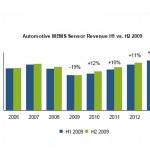
Microelectromechanical (MEMS) sensors are used extensively in automotive applications but like everything else automotive, 2009 was not a good year. Richard Dixon of iSuppli forecasts that global shipments of automotive MEMS sensors will reach 591.2 million units in 2010, up 13.5% from 502.0 million in 2009. The second half will be up from the first and the increasing trend will continue through 2013. In fact, some MEMS products such as pressure sensors are experiencing shortages. The report “Automotive MEMS H1 2010 Market Tracker” provides more details.
For more information on iSuppli’s Automotive MEMS H1 2010 Market Tracker report click here.
Yole Developpement Forecasts Growth for MEMS & Sensors in Smartphones

June 30, 2010 by Randy Frank
Filed under Featured, Market Research
At mid-year 2010, it’s time for market research companies to reaffirm or reevaluate their positions and forecasts for 2010. Here is the first of three newly released reports that involve sensors.
In the report “MEMS & Sensors for Smartphones,” Yole Developpement predicts double digit growth for MEMS & sensors for cell phones, expanding from $3.5B in 2009 to $7.9B in 2015. Among the sensors covered in report are MEMS gyroscopes, accelerometers and pressure sensors. CMOS image sensors are also included.
For more information on Yole Developpement’s report “MEMS & Sensors for Smartphones,” including a sample download and product leaflet with more information, click here.
Millivolt Low Voltage Pressure Sensors from All Sensors
Morgan Hill, CA - All Sensors Corporation has announced a new line of Millivolt Low Voltage Pressure Sensors. The new Millivolt Low Voltage Pressure Sensors (MLV Series) are based upon All Sensors’ CoBeam2™ Technology. CoBeam2™ Technology helps reduce package stress as well as greatly improves position sensitivity when compared with competitive sensors. The MLV Series device has a temperature compensated output signal and is calibrated for zero and span. By offering a compensated and calibrate output signal, many errors associated with pressure measurement are corrected, offering an accurate and stable signal. The MLV Series device provides a high output signal at a low operating voltage. This is the result of an extremely sensitive sensing element capable of operating at low supply voltages. Lower operating voltages result in improved errors due to warm-up shift. The MLV Series afford design engineers a new compensated millivolt pressure sensor capable of low pressure measurement with improved energy efficiency. The Millivolt Low Voltage (MLV) Series is available in 1, 5, 10, 20, and 30 inH2O pressure ranges.

The MLV Series is offered in a pc board mountable package. Several packages and port configurations are available including gage and differential devices. The MLV Series employs All Sensors’ CoBeam2 TM Technology. The device provides a compensated and calibrated mV output signal. The MLV Series device is specified at 5 volt excitation with just over 2mW power consumption.
Ideal applications for this device are; portable devices, battery operated devices, medical breathing, medical devices associated with low pressure, remote sensing, HVAC, and industrial controls.
All Sensors Corporation
www.allsensors.com
Pressure Sensors Built For Industrial Use
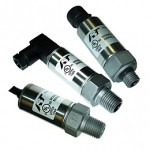
Bestech Australia has released the AST4000 industrial grade pressure sensors for a range of applications.
With a one-piece stainless steel sensing element, the sensor is used in rugged environments where a high cycle life and media compatibility.
The sensor features a wide operating temperature range, is compatible with a range of liquids and gases, has no oil, welds or internal O-rings and ranges up to 10 000 psi.
It is designed for use in water management, pneumatic and hydraulic equipment, HVAC equipment and for industrial OEM equipment.
The pressure sensor’s accuracy is below ±0.5% and it has an environmental protection rating of IP-66.
The analog outputs include 4-20 mA, 1-5/1-6 VDC, 0-50 mV and 0.5 to 4.5 ratiometric.
The AST4000 comes with a variety of threads, pressure ranges, outputs and electrical connections in order to make system integration seamless.
Optical Sensor Skin Gives Robots Human Touch
In recent years, lots of efforts have been made to give robots the ability to hear and see. But what about the sense of touch? Unlike us, robots don’t have sensitive skin. But this is about to change. By using organic, or plastic, field-effect transistors as pressure sensors deposited on a flexible material, researchers at the University of Tokyo have created an artificial skin which will give the robots the sense of touch. The prototype has a density of 16 sensors per square centimeter, far from the 1,500 of our fingertips. When this density increases and when the problem of the reliability of this kind of transistors is solved, the researchers say this artificial skin will also be used for car seats or gym carpets. Expect to see them in four or five years. Read more…
Here are selected excerpts from the Technology Research News article.
Researchers from the University of Tokyo have devised pressure-sensor arrays that promise to give objects like rugs and robots the equivalent of one aspect of skin — pressure sensitivity.
The researchers’ pressure sensor arrays are built from inexpensive organic, or plastic, transistors on a flexible material. This allows for dense arrays that can be used over large areas.
The arrays could be used in pressure-sensitive coverings in hospitals, homes, gyms and cars to monitor people’s health and performance, and eventually as skin that would give robots the means to interact more sensitively with their surroundings, said Takao Someya, an associate professor of electrical engineering at the University of Tokyo.
The sensor skin works even when rolled around a cylinder as small as 4 millimeters in diameter, said Someya. The researchers’ prototype is an eight-centimeter-square sheet containing a 32-by-32 array of organic sensors — a density of 16 sensors per square centimeter. In contrast, humans have 1,500 pressure sensors per square centimeter in the fingertips, though far fewer in most other places.
![]() |
Here is a picture of a robotic hand using organic transistors as pressure sensors. (Credit: Takao Someya) |
And what are possible applications?
The active-matrix design allows the arrays to be smart enough to enable specific sensors at certain feedback points to, for instance, monitor the heart and breathing rate of a hospital patient who has fallen to the floor, said Someya. The skin could measure whether an elderly patient is just taking a rest, or needs help, he said.
The skin could also be used in car seats to monitor drivers’ mental and physical conditions, Someya said. “Our large-area pressure [sensing abilities] would be helpful” in obtaining information through drivers seats, he said.
And, of course, we’ll see home robots able to pick an egg in the fridge.
The research work has been published by the Proceedings of the National Academy of Sciences on July 6, 2004, under the title “A large-area, flexible pressure sensor matrix with organic field-effect transistors for artificial skin applications.”
Cognex Introduces DataMan 200 ID Reader
April 29, 2009 by R. Nelson Parrish
Filed under Image
Cognex Corporation (NASDAQ: CGNX) announces the newest addition to its DataMan® family of ID readers. The new DataMan 200 adds Ethernet connectivity and liquid lens technology to the world’s smallest high performance fixed-mount reader. These new features enable faster communication speed, easier integration with factory controls, and software-driven autofocus for easy, hands-free setup.

Ethernet connectivity gives DataMan 200 users the advantage of real-time data and image transfer, and easier integration with plant controllers and information networks.
Liquid lens technology, an optional feature of the DataMan 200, provides greater focal range, ease of setup, and faster response time. This unique technology adjusts the camera’s focus by applying an electrical charge to fluid within the lens.
With liquid lens technology, autofocus is achieved with a single software command. The lens also provides exceptional depth of field and field of view range, and, because it has no moving parts to malfunction or break down with use, the system is extremely rugged and resistant to shock, vibration and wear.
Setup is simplified with the use of two laser aimers. The laser targets are easily seen through the entire depth of field, enabling operators to quickly position the code to the reader.
Like the DataMan 100, the new system features an easy-to-use interface for setting up the application, and supports a wide range of 1D and 2D codes including UPC/EAN/JAN, Code 39, Code 128, Code 93, Interleaved 2 of 5, Data Matrix, QR Code, and micro QR Code.
Cognex
www.cognex.com/dm200
Kavlico Pressure Sensors for Hydraulic Applications
April 14, 2009 by R. Nelson Parrish
Filed under Pressure
Moorpark, CA – Kavlico has a suite of sensors that have been designed to perform in a wide variety of hydraulic applications. Capable of operating for millions of pressure cycles, these low power consumption pressure sensors provide an accurate, reliable, and stable signal over many years of operation in the harshest environments. The high overpressure capability of our sensors for fluid power applications are designed to withstand the pressure fluctuations associated with these applications.

These rugged devices have stainless steel housings and can be configured with a broad selection of process and electrical connectors to fit the specification criteria for each application. Operating on 5 Vdc, the sensors provide a 0.5 to 4.5 linear amplified output proportional to pressure. Pressure ranges are available up to 6,000 PSI.
Typical pressure sensor applications include:
•On & off-highway and vocational vehicle hydraulic systems
•Trenching machines
•Pressurized tools
•Adaptive suspension systems
•Material testing
•Lifts
•Cargo loading systems
•Transmissions
•Hydraulic applications for heavy equipment
Kavlico sensors for Hydraulic applications include:
•P4000 – Sealed High Pressure Sensor
•P250/P251 – Sealed Industrial Pressure Sensor
Micro-machined Silicon Pressure Transducers
March 25, 2009 by R. Nelson Parrish
Filed under Pressure
Omegadyne announces the most durable version of its high accuracy MM Series micro-machined silicon pressure transducers. The new hermetically sealed version of the MM Series features all welded Stainless Steel construction, 316 wetted parts and glass to metal seals (GMS) at the electrical outlets. This ensures that the unit is hermetically sealed from external environments and the media. Designed for use on automotive and aircraft test platforms and anywhere environmental concerns demand the most durable characteristics.

The sealed MMA500V Series has a micro machined silicon core that provides high accuracy, low drift and excellent long term stability in the harshest environments. Ranges from 100 psi to 5000 psi, accuracies from 0.08% to 0.03% and a variety of pressure and electrical connections make this MMA500V Series Transducer extremely versatile. The temperature compensation range can be as broad as -40 to 200*F (-40 to 104*C) and thermal errors as low as +/- 0.3% over the compensated range. Operating temperature range is -49 to 250*C (-45 to 121*C). The MMA500V Series design is further ruggedized with a secondary containment system in the event of diaphragm rupture. A 5-Point NIST traceable calibration certificate included.
The MM Series pressure transducers offer “Custom Designed” features with fast delivery. Our modular design allows you to construct a pressure sensor to meet your application requirements, with guaranteed fast delivery… typically from stock to 2 weeks. Our product configurator found online at omegadyne.com allows quick and easy configuration of a transducer that meets the exact needs of your project.
High Accuracy Pressure Transducer
Mt. Olive, NJ – American Sensor Technologies, Inc. (AST) unveils the new digitally compensated, CE approved, AST20HA high accuracy pressure transducer to complement it’s existing OEM and Hazardous Area pressure sensing products. This model is intended for use in applications requiring high performance over a range of operating conditions at an affordable price. The AST20HA is extremely versatile and suitable for a variety of applications including, but no limited to: test stands, hydrogen filling stations, medical laboratories and military/aerospace vehicles and equipment.

The AST20HA’s ASIC design features real time thermal compensation and linearity correction, enabling it to excel in dynamic temperature environments where ordinary sensors fail. Furthermore, its one piece stainless steel construction is built upon the proven performance of AST’s Krystal Bond™ Technology, bringing the AST20HA into it’s own league of high performance pressure sensing. The AST20HA contains no internal o-rings, taking the guesswork out of o-ring to media compatibility, and is equipped with 100V/m of EMI/RFI protection from electrical noise. The low operating strain of the diaphragm offers excellent non-repeatability and long-term stability.
Moreover, this model operates at a wide temperature range (-40°F to 185°F) and offers pressure ranges up to 10,000psi. More specifically, the AST20HA series provides pressure ranges from 0-25 psi to 0-10,000 psi and is available in compound ranges up to 2500 psi. Output options include: 4-20mA, 1-5V, 1-10V, and 0.5 – 4.5V ratiometric.