• Skip to primary navigation
  • Skip to main content
  • Skip to primary sidebar
  • Skip to footer
  • Subscribe
  • Advertise

Sensor Tips

Sensor Product News, Tips, and learning resources for the Design Engineering Professional.

  • Motion Sensing
  • Vision systems
    • Smart cameras
    • Vision software
    • Lighting
    • Optics
  • Pressure
  • Speed
  • Temperature
  • Suppliers
  • Video
    • EE Videos
    • Teardown Videos
  • EE Learning Center
    • Design Guides
    • Tech Toolboxes

High optical output laser diode targets LiDAR apps

October 11, 2021 By Redding Traiger Leave a Comment

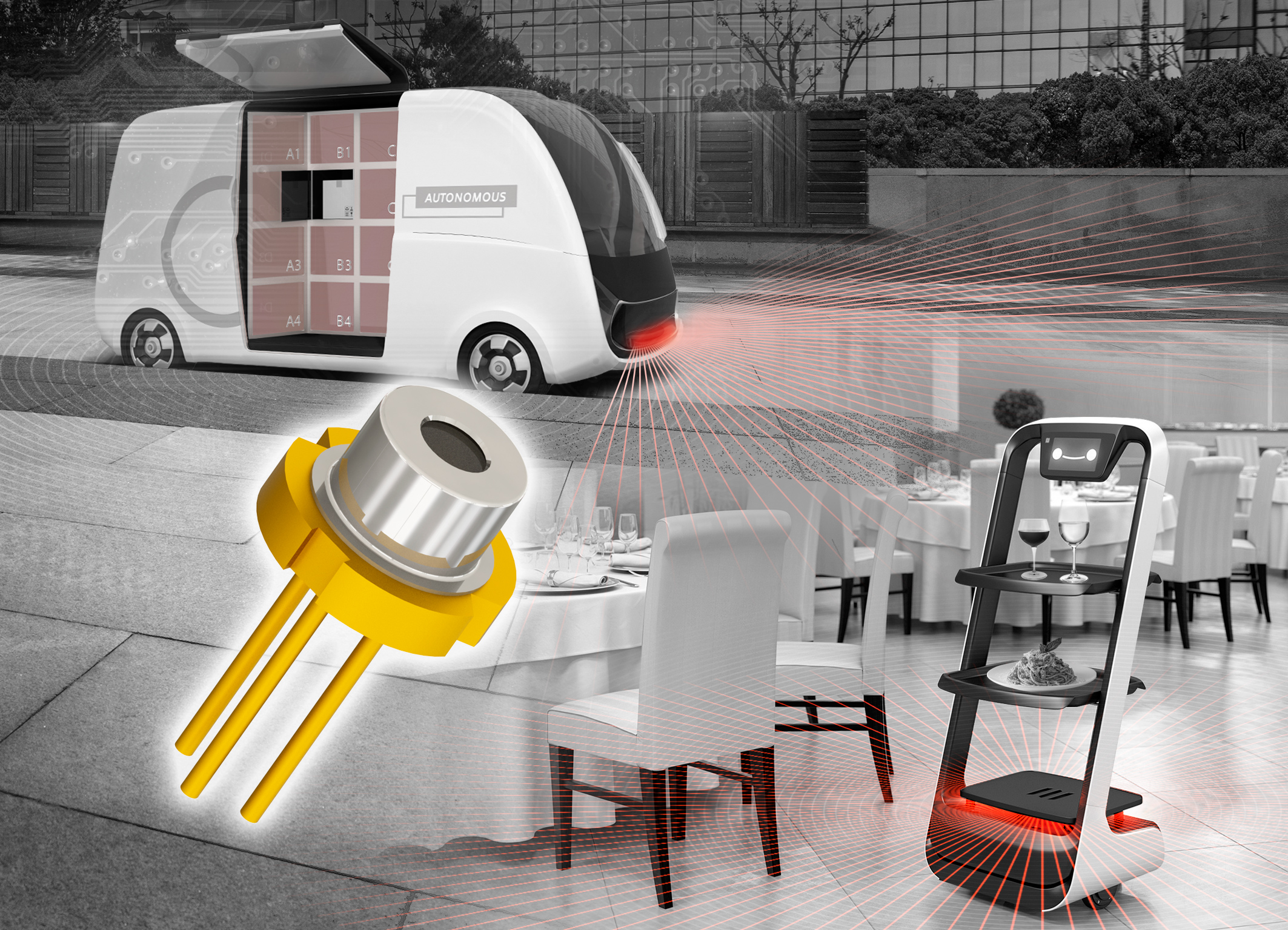
ROHM Semiconductor announced they have developed a high optical output laser diode, the RLD90QZW3, for applications such as AGVs (Automated Guided Vehicles) and service robots in the industrial equipment sector and robot vacuums in the consumer field that incorporate LiDAR for distance measurement and spatial recognition.

In recent years, LiDAR has been increasingly adopted in a wide range of applications that need to be automated to precisely measure distance and for spatial recognition. For such market trends, there is a need to improve the performance of laser diodes when used as light sources to increase detection distance and accuracy, while reducing power consumption.

ROHM meets this market requirement by establishing original patented technology to achieve narrower emission width. This contributes to a longer range and higher accuracy in LiDAR applications. In 2019, ROHM released the RLD90QZW5 25W laser diode that has been adopted primarily in the consumer electronics sector. This product expands applicability in the industrial sector by providing higher optical output.

The new RLD90QZW3 is a 75W infrared high optical output laser diode designed for LiDAR used in distance measurement and spatial recognition in 3D ToF (Time of Flight) systems. Leveraging original device development technology allows ROHM to achieve an unprecedented emission width of 225μm at the equivalent optical output. This is 22% narrower than conventional products, improving beam characteristics. At the same time, uniform emission intensity together with low-temperature dependence of the laser wavelength ensure stable performance – contributing to higher accuracy and expanding longer distances in various LiDAR applications. Moreover, a power conversion efficiency (which is a trade-off with narrow emission width) of 21% – the same as standard products (at a forward current of 24A and 75W output) – enables use without increased power consumption.

A broad range of design support data is also available on ROHM’s website free of charge, including optical circuit simulation models and application notes on drive circuit design. This is necessary for integration and evaluation that supports quick market introduction.


You may also like:


  • What is the role of sensor fusion in robotics?
  • touchless touch sensing
    How can you have touchless touch sensing?

  • How can picture-like images be obtained from LiDAR?
  • robots
    What types of sensors are used in robots? Part 1…

  • What position is this thing in?

Filed Under: laser, Optical Tagged With: ROHM Semiconductor

Reader Interactions

Leave a Reply

You must be logged in to post a comment.

Primary Sidebar

Featured Contributions

Automotive sensor requirements for software-defined vehicles: latency, resolution, and zonal architecture

High-current, low-impedance systems need advanced current sensing technology

A2L refrigerants drive thermal drift concerns in HVAC systems

Integrating MEMS technology into next-gen vehicle safety features

Fire prevention through the Internet

More Featured Contributions

EE TECH TOOLBOX

“ee
Tech Toolbox: Sensors
In this Tech Toolbox, we cover some of those technologies driving the next generation of connected systems, including ultra-low-power sensing strategies that extend node battery life, and 60 GHz CMOS radar for contactless health and presence detection.

EE LEARNING CENTER

EE Learning Center
“sensor
EXPAND YOUR KNOWLEDGE AND STAY CONNECTED
Get the latest info on technologies, tools and strategies for EE professionals.

RSS Current EDABoard.com discussions

  • MOSFET Characterization in Cadence
  • measuring time domain skew between two lines on a differential transmission
  • Questions to negative impedance converters
  • Output short circuit protection for SMPS's
  • Old Generation MOSFETs that will be obsolete in the coming decade?

RSS Current Electro-Tech-Online.com Discussions

  • Voltage comparator circuit verification
  • What is this???
  • infiniBand Layer 1 specifications testing question
  • Why aren’t the power windows in my 2006 Volkswagen Polo 2006 working despite repairing the control unit circuit board?
  • block RF

EE ENGINEERING TRAINING DAYS

engineering
“bills

RSS Featured White Papers

  • 4D Imaging Radar: Sensor Supremacy For Sustained L2+ Vehicle Enablement
  • Amphenol RF solutions enable the RF & video signal chains in industrial robots
  • Implementing Position Sensors for Hazardous Areas & Safety

Footer

EE WORLD ONLINE NETWORK

  • 5G Technology World
  • EE World Online
  • Engineers Garage
  • Analog IC Tips
  • Battery Power Tips
  • Connector Tips
  • EDA Board Forums
  • Electro Tech Online Forums
  • EV Engineering
  • Microcontroller Tips
  • Power Electronic Tips
  • Test and Measurement Tips

SENSOR TIPS

  • Subscribe to our newsletter
  • Advertise with us
  • Contact us
  • About us

Copyright © 2026 · WTWH Media LLC and its licensors. All rights reserved.
The material on this site may not be reproduced, distributed, transmitted, cached or otherwise used, except with the prior written permission of WTWH Media.

Privacy Policy