The first part of this article looked at the challenges of sensing nano-level flow rates such as found in the blood vessels. In contrast, the second part looked at graphene, an allotrope of elemental carbon at the heart of a new sensor used to measure those flows. This third and final part looks at the research project itself, which devised a sensor for these flow rates as low as a micrometer per second (equivalent to less than four millimeters per hour) while also offering short- and long-term stability and high performance.
The goal was to build a self-powered microdevice which can convert, in real-time, the flow of continuous pulsating blood flow in a microfluidic channel to a charge-transfer current in response to changes at the graphene-aqueous interface. The team achieved this by using a single microelectrode of monolayer graphene that harvests charge from flowing blood through contact electrification without the need for an external current supply.
They fabricated acrylic chips with a graphene single-microelectrode device extending over the microfluidic channel (Figure 1). To do this, they prepared the monolayer graphene via chemical vapor deposition (CVD) and transferred it to the chip using electrolysis. For basic tests, they used a syringe pump to drive a flow of anticoagulated whole-bovine with a precisely controlled velocity through the microfluidic channel.
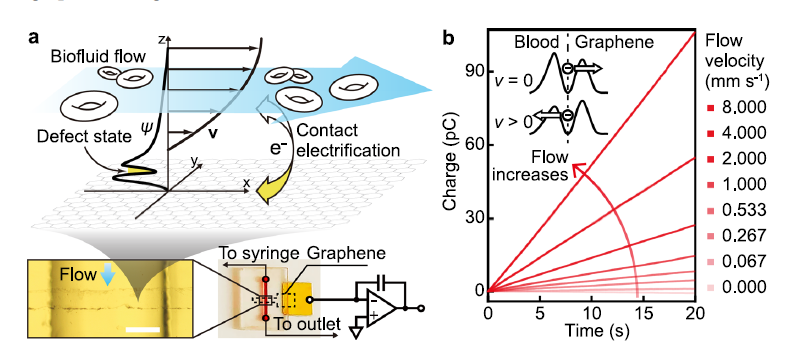
They then wired the graphene microelectrode to the inverting input of an operational amplifier (op amp) of a coulombmeter. The charge harvested from the solution by the graphene was stored in a feedback capacitor of the amplifier and quantified. The charge-transfer current of the graphene device was linearly related to the blood-flow velocity (Figure 2), resulting in a proportional relationship between the current response (the flow-induced current variation relative to the current at zero flow velocity) and the flow velocity (Figure 3).

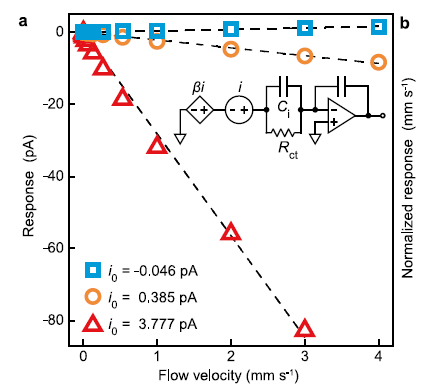
The sensor device provided a resolution of 0.49 ± 0.01 μmeter/sec (at a 1-Hz bandwidth), a substantial improvement of about two orders-of-magnitude compared to existing device-based flow-sensing approaches, while the ultrathin (one-atom-layer) device was at low risk of being fouled or causing channel clogging.
As with any sensor, there are always concerns about short-term and long-term stability and consistency. For the former, they measured the real-time flow velocity in response to a continuous five-step blood flow that lasted for more than two hours. The measured velocity showed high repeatability with minimal fluctuations of ±0.07 mm/second. For the latter test, they evaluated a device performing intermittent measurements for periods of six months. The blood-flow sensitivity of the device fluctuated around an average value of 0.39 pA-sec /mm with a standard deviation of ±0.02 pA-sec/mm, equivalent to ±5.1% of the average value. These numbers are indicative of minimal variations in key performance metrics (Figure 4).

The details of the project, including the required chemical preparations, test arrangements, and related processes, are in their primary paper, “Flow-sensory contact electrification of graphene” published as a pdf in Nature Communications. The non-pdf web version also has links to their Supplementary Information, plus a 30-second video of the signals with a separate link for the caption of the video.
Conclusion
As with so much basic research, you never know what the utility or applications of the result will be (no one foresaw the development of the atomic and molecular beam magnetic resonance method of observing atomic spectra and nuclear magnetic resonance (NMR) in 1937 by Isidor I. Rabi would lead to the development of MRI imaging technology in the late 1960 and early 1970s – they seem to be two totally unrelated items. The development of elusive graphene and its subsequent availability as a standard commercial product has opened opportunities for exploiting its unique and somewhat bizarre properties across many commercial products as well as scientific functions.
EE World Related Content
- Graphene solid state devices – What does the future hold?
- AstroSlide 5G phone: Electronics and graphene will make it run
- Coriolis flowmeters: A subtle global effect with local applications, Part 1: The challenge
- Coriolis flowmeters, Part 2: The principle
- Coriolis flowmeters, Part 3: Flowmeter design
- Coriolis flowmeter, Part 4: The future
- Magnetic resonance imaging (MRI), Part 1: How it works
- MRI, Part 2: Historical development (and lawsuits)
- TT Electronics’ Self-Calibrating Fluid Sensors Enable Engineers to Easily Correct for System Variations
- Wafer-based Tunneling Magnetoresistive analog sensor targets fluid measurement apps
- The working principle, applications and limitations of ultrasonic sensors
External References
Graphene related
- Encyclopædia Britannica, Inc., “Graphite”
- Graphene Info, “What is Graphene?”
- Manchester University, National Graphene Institute (NGI)
- Scientific American, “Carbon Wonderland” (2008)
- APS News, “Discovery of Graphene” (2004)
- Science, “Electric Field Effect in Atomically Thin Carbon Films” (2004) (behind a paywall)
- ResearchGate, “Electric Field Effect in Atomically Thin Carbon Films” (no paywall)
- YouTube, “Electric Field Effect in Atomically Thin Carbon Films” (20-minute video)
Flow Sensor related
- Nature Communications, “Flow-sensory contact electrification of graphene” (pdf)
- Nature Communications, “Flow-sensory contact electrification of graphene” (non-pdf web version)
- Nature Communications, “Supplementary Information”
- Untitled 30-second video plus caption of the video
- University of Massachusetts, “UMass Amherst Researchers Develop Ultra-Sensitive Flow Microsensors”