
• Skip to primary navigation
  • Skip to main content
  • Skip to primary sidebar
  • Skip to footer
  • Subscribe
  • Advertise

Sensor Tips

Sensor Product News, Tips, and learning resources for the Design Engineering Professional.

  • Motion Sensing
  • Vision systems
    • Smart cameras
    • Vision software
    • Lighting
    • Optics
  • Pressure
  • Speed
  • Temperature
  • Suppliers
  • Video
    • EE Videos
    • Teardown Videos
  • EE Learning Center
    • Design Guides
    • Tech Toolboxes

How has sensing in industrial automation changed? (Part 2)

January 27, 2022 By Randy Frank Leave a Comment

Sensing has changed a lot since the early days of industrial automation.

“Back 250 years ago, your sensors were actually people. They were your manufacturing engineers that would walk around and listen to the machines and hear what’s going on,” says John Tuley, from IoT Business Development -Sensor Solutions at TE Connectivity.
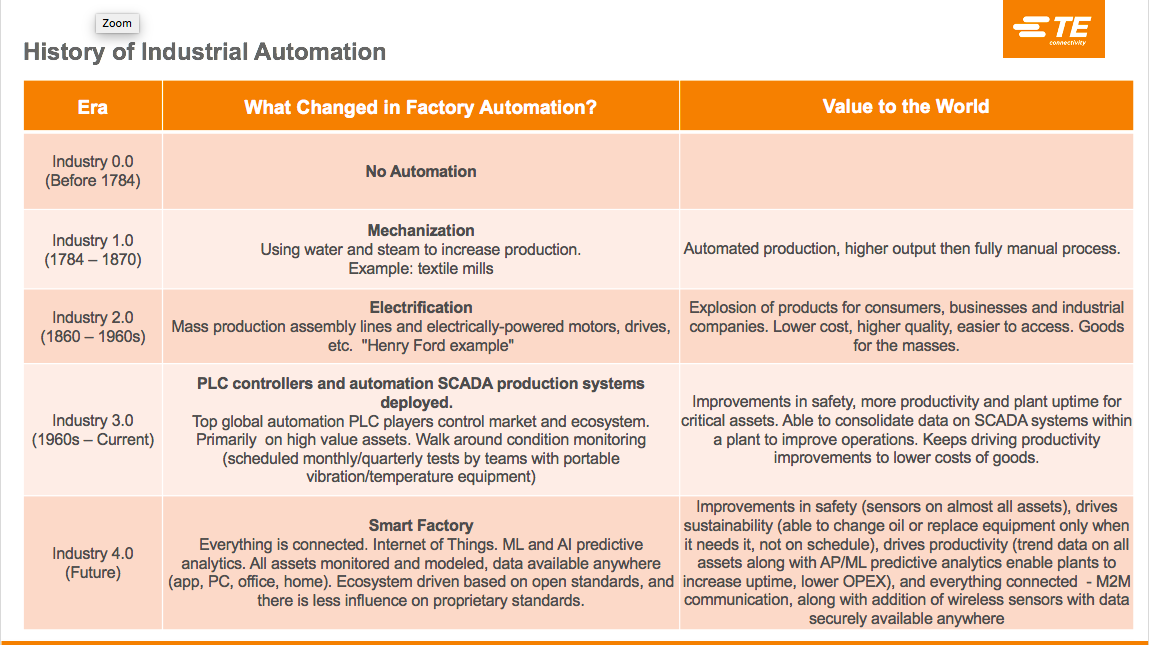
In Industry 4.0, wireless connectivity allows sensors to easily be deployed in places that would have been much more difficult or prohibitive in the past. Motors, pumps, conveyor systems and much more are all candidates for wireless diagnostic sensors.

“Instead of having to run power and signal [wiring], for relatively low-cost points, you could start sensorizing assets you couldn’t do in the past,” says Tuley. “That gives the factory so much more information to be able to use and promote up time.”

With smart phone monitoring of critical activities through wireless sensors, a maintenance manager can be far away from the machine and still know what is happening or about to happen if the proper actions are not taken. They can know many situations beforehand and send the appropriate people to the right locations. This can be extremely important in these ongoing pandemic days, where the people challenge is real in many factories.

“If you have ten people in a plant that normally has 20 maintenance guys, you want to make sure that you send those guys to the right place,” explains Tuley.

As far as sensor parameters that enable Industry 4.0, lower power consumption to maximize battery life, lower cost for affordability and smaller size so the sensor can fit into more applications are among the typical customer requirements. One of the solutions to improve the sensor’s viability is combo sensors. Instead of a single sensor, two or more are integrated into the package.

“An example is a fluid property sensor that does five different measurements on fluids for hydraulic systems for the ICT market,” says Tuley.

Specifically, the OPS3 Oil Property Sensor (OPS) senses 5 different aspects of fluids: dynamic viscosity, density, dielectric constant, resistance (Rp) and temperature of oils.

The discussion with TE Connectivity’s John Tuley concludes in the next part of this series.
You may also like:


  • How has sensing changed in industrial automation? (Part 1)

Filed Under: Featured, Frequently Asked Question (FAQ) Tagged With: TE Connectivity

Reader Interactions

Leave a Reply

You must be logged in to post a comment.

Primary Sidebar

Featured Contributions

Automotive sensor requirements for software-defined vehicles: latency, resolution, and zonal architecture

High-current, low-impedance systems need advanced current sensing technology

A2L refrigerants drive thermal drift concerns in HVAC systems

Integrating MEMS technology into next-gen vehicle safety features

Fire prevention through the Internet

More Featured Contributions

EE TECH TOOLBOX

“ee
Tech Toolbox: Test & Measurement
We’ve gathered articles that include hands-on product tryouts and reviews. Indeed, every article in this issue uses an oscilloscope in one way or another so you might just call this “The Oscilloscope Tech Toolbox.”

EE LEARNING CENTER

EE Learning Center
“sensor
EXPAND YOUR KNOWLEDGE AND STAY CONNECTED
Get the latest info on technologies, tools and strategies for EE professionals.

RSS Current EDABoard.com discussions

RSS Current Electro-Tech-Online.com Discussions

  • EEPROM not being written or read on dsPIC30F2010
  • 12VDC ( 10 - 24 V ) to 0 to +/- 30VDC 1A dual tracking psu - for sale
  • What is involved to convert a small town to fiber optic?
  • volkswagen car stereo model rcd310
  • Dog fence help

EE ENGINEERING TRAINING DAYS

engineering
“bills

RSS Featured White Papers

  • 4D Imaging Radar: Sensor Supremacy For Sustained L2+ Vehicle Enablement
  • Amphenol RF solutions enable the RF & video signal chains in industrial robots
  • Implementing Position Sensors for Hazardous Areas & Safety

Footer

EE WORLD ONLINE NETWORK

  • 5G Technology World
  • EE World Online
  • Engineers Garage
  • Analog IC Tips
  • Battery Power Tips
  • Connector Tips
  • EDA Board Forums
  • Electro Tech Online Forums
  • EV Engineering
  • Microcontroller Tips
  • Power Electronic Tips
  • Test and Measurement Tips

SENSOR TIPS

  • Subscribe to our newsletter
  • Advertise with us
  • Contact us
  • About us

Copyright © 2025 · WTWH Media LLC and its licensors. All rights reserved.
The material on this site may not be reproduced, distributed, transmitted, cached or otherwise used, except with the prior written permission of WTWH Media.

Privacy Policy
