
• Skip to primary navigation
  • Skip to main content
  • Skip to primary sidebar
  • Skip to footer
  • Subscribe
  • Advertise

Sensor Tips

Sensor Product News, Tips, and learning resources for the Design Engineering Professional.

  • Motion Sensing
  • Vision systems
    • Smart cameras
    • Vision software
    • Lighting
    • Optics
  • Pressure
  • Speed
  • Temperature
  • Suppliers
  • Video
    • EE Videos
    • Teardown Videos
  • EE Learning Center
    • Design Guides
    • Tech Toolboxes

TURCK Linear position Sensors Replace Magnetostrictive and Potentiometer Devices

March 5, 2010 By sensortipsadmin Leave a Comment

Minneapolis, MN — TURCK’s new LI-Q25 series linear position sensors replace magnetostrictive and potentiometer devices to deliver precise, repeatable measurements in metal processing machines, rolling mills or injection molding machines. Unlike magnetostrictive or magnetic inductive position sensors, LI-Q25 sensors do not require a magnetic positioning device; thus, they are unaffected by metal debris. The sensors provide up to 1 µm resolution and can achieve measuring ranges between 100 and 1,000 mm with analog voltage/current, SSI or I/O Link outputs.
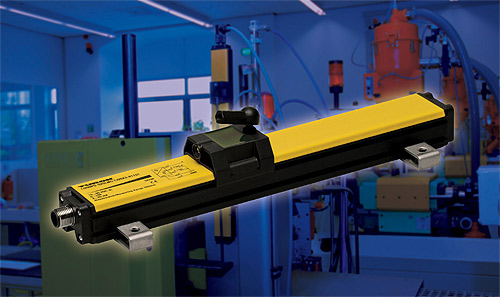
LI-Q25-Series-Linear-Position-Sensor

The linear position sensors use emitter and receiver coil systems, precisely arranged on a printed circuit board, that are activated with a high frequency AC field and produce an inductive RLC circuit with the positioning element (resonator). As a result, the resonator is inductively coupled with the receiver coils. Different voltages are induced into the coils depending on the position of the resonator, and these voltages serve as a measure for the sensor signal.

To increase the speed and accuracy of measurement, LI-Q25 series linear position sensors have a coarse and a fine measuring coil system that is microprocessor controlled. An integrated processor provides an output signal in different formats: 0 to 10 V, 4 to 20 mA, IO-Link or SSI.

The linear position sensors have extremely short blind zones of only 29 mm on each side, along with a wide temperature range of -25 to 70°C. The sensors may also be programmed for different measuring ranges.

TURCK
www.turck.us

Filed Under: Featured, Position Tagged With: li-q25, linear position, position sensor, sensor, turck

Reader Interactions

Leave a Reply

You must be logged in to post a comment.

Primary Sidebar

Featured Contributions

Automotive sensor requirements for software-defined vehicles: latency, resolution, and zonal architecture

High-current, low-impedance systems need advanced current sensing technology

A2L refrigerants drive thermal drift concerns in HVAC systems

Integrating MEMS technology into next-gen vehicle safety features

Fire prevention through the Internet

More Featured Contributions

EE TECH TOOLBOX

“ee
Tech Toolbox: Connectivity
AI and high-performance computing demand interconnects that can handle massive data throughput without bottlenecks. This Tech Toolbox explores the connector technologies enabling ML systems, from high-speed board-to-board and PCIe interfaces to in-package optical interconnects and twin-axial assemblies.

EE LEARNING CENTER

EE Learning Center
“sensor
EXPAND YOUR KNOWLEDGE AND STAY CONNECTED
Get the latest info on technologies, tools and strategies for EE professionals.

RSS Current EDABoard.com discussions

RSS Current Electro-Tech-Online.com Discussions

  • Op amp shock
  • CR2/CR123A Batteries In Projects
  • Variable audio oscillator
  • Do i need a buffer?
  • ANOTHER OLD PROJECT REDO

EE ENGINEERING TRAINING DAYS

engineering
“bills

RSS Featured White Papers

  • 4D Imaging Radar: Sensor Supremacy For Sustained L2+ Vehicle Enablement
  • Amphenol RF solutions enable the RF & video signal chains in industrial robots
  • Implementing Position Sensors for Hazardous Areas & Safety

Footer

EE WORLD ONLINE NETWORK

  • 5G Technology World
  • EE World Online
  • Engineers Garage
  • Analog IC Tips
  • Battery Power Tips
  • Connector Tips
  • EDA Board Forums
  • Electro Tech Online Forums
  • EV Engineering
  • Microcontroller Tips
  • Power Electronic Tips
  • Test and Measurement Tips

SENSOR TIPS

  • Subscribe to our newsletter
  • Advertise with us
  • Contact us
  • About us

Copyright © 2026 · WTWH Media LLC and its licensors. All rights reserved.
The material on this site may not be reproduced, distributed, transmitted, cached or otherwise used, except with the prior written permission of WTWH Media.

Privacy Policy