
• Skip to primary navigation
  • Skip to main content
  • Skip to primary sidebar
  • Skip to footer
  • Subscribe
  • Advertise

Sensor Tips

Sensor Product News, Tips, and learning resources for the Design Engineering Professional.

  • Motion Sensing
  • Vision systems
    • Smart cameras
    • Vision software
    • Lighting
    • Optics
  • Pressure
  • Speed
  • Temperature
  • Suppliers
  • Video
    • EE Videos
    • Teardown Videos
  • EE Learning Center
    • Design Guides
    • Tech Toolboxes

What makes a cobot unique from a robot?

June 20, 2022 By Randy Frank Leave a Comment

Unlike robots whose roots trace back to 1962 or even sooner, collaborative robots or cobots trace their roots to 1996 – over 34 years later. While the robot is an autonomous machine that functions without human control, a cobot employs artificial intelligent (AI) to perform tasks in collaboration with human workers. Major sensors used in robots include torque, force, optical, position, and temperature. Since the cobot must work safely with humans, sensors for safe operation are a critical factor. For example, to comply with functional safety requirements up to ISO13849 Safety of machinery — Safety-related parts of control systems, Category 3 PL d, TE Connectivity’s (TE) safety torque sensor’s design is based on a dual-channel system and includes other features to detect any safety related failures.
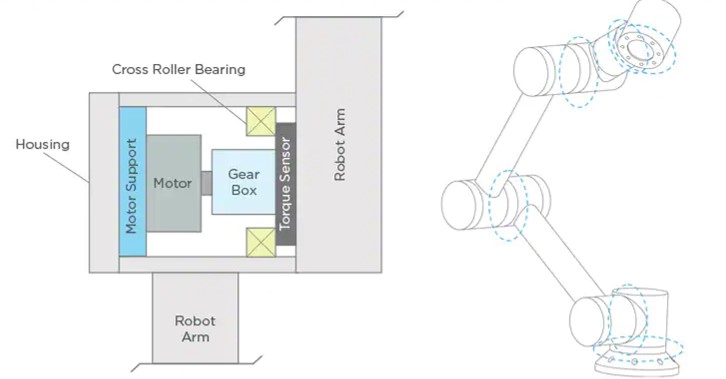
Designed to monitor the mechanical torque in a variety of the rotational pivot points on a cobot, the torque sensor is based on an integrated MEMs load cell that can translate mechanical torque to a digital output signal proportional to the torque applied. In the cobot, the sensor detects conditions where the torque level is high enough to potentially harm a human in a collaborative application or where the torque level could damage the cobot itself.

The torque sensor starts with a one-piece flexure designed to translate rotational torque into mechanical strain. Piezoresistive strain gauges attached to the flexure areas and assembled in a Wheatstone bridge configuration translate the mechanical strain to a mV/V output. Two small printed circuit boards (PCBs) on the sensor house an ASIC and other electrical components. The circuitry compensates, amplifies, digitizes and communicates the raw mV/V signal in an I2C format. Also, a torque threshold can be established to shut down the cobot before any humans are injured or before any damage occurs to the cobot itself.

“Installed at each joint, TE’s torque sensors improve accuracy and response time of collision detection in addition to improved resolution of manual arm positioning or “teaching,” says Ricardo Garcia, Product Manager, Force and Torque Sensors, TE Connectivity.
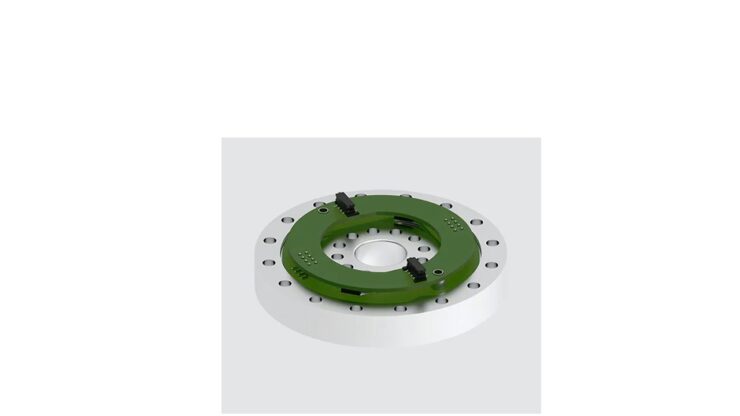
Providing safety critical collision sensing in collaborative robots, the overall height of TE’s low profile safety torque sensor is less than 20 mm. The cobot torque sensor operates in both the clockwise and counterclockwise directions and has a full-scale range of 20 – 500 Nm (15 – 400 lbf) with a static rotation speed.

Filed Under: Featured, Frequently Asked Question (FAQ), Torque Tagged With: TE Connectivity

Reader Interactions

Leave a Reply

You must be logged in to post a comment.

Primary Sidebar

Featured Contributions

Automotive sensor requirements for software-defined vehicles: latency, resolution, and zonal architecture

High-current, low-impedance systems need advanced current sensing technology

A2L refrigerants drive thermal drift concerns in HVAC systems

Integrating MEMS technology into next-gen vehicle safety features

Fire prevention through the Internet

More Featured Contributions

EE TECH TOOLBOX

“ee
Tech Toolbox: Test & Measurement
We’ve gathered articles that include hands-on product tryouts and reviews. Indeed, every article in this issue uses an oscilloscope in one way or another so you might just call this “The Oscilloscope Tech Toolbox.”

EE LEARNING CENTER

EE Learning Center
“sensor
EXPAND YOUR KNOWLEDGE AND STAY CONNECTED
Get the latest info on technologies, tools and strategies for EE professionals.

RSS Current EDABoard.com discussions

RSS Current Electro-Tech-Online.com Discussions

  • EEPROM not being written or read on dsPIC30F2010
  • 12VDC ( 10 - 24 V ) to 0 to +/- 30VDC 1A dual tracking psu - for sale
  • What is involved to convert a small town to fiber optic?
  • volkswagen car stereo model rcd310
  • Dog fence help

EE ENGINEERING TRAINING DAYS

engineering
“bills

RSS Featured White Papers

  • 4D Imaging Radar: Sensor Supremacy For Sustained L2+ Vehicle Enablement
  • Amphenol RF solutions enable the RF & video signal chains in industrial robots
  • Implementing Position Sensors for Hazardous Areas & Safety

Footer

EE WORLD ONLINE NETWORK

  • 5G Technology World
  • EE World Online
  • Engineers Garage
  • Analog IC Tips
  • Battery Power Tips
  • Connector Tips
  • EDA Board Forums
  • Electro Tech Online Forums
  • EV Engineering
  • Microcontroller Tips
  • Power Electronic Tips
  • Test and Measurement Tips

SENSOR TIPS

  • Subscribe to our newsletter
  • Advertise with us
  • Contact us
  • About us

Copyright © 2025 · WTWH Media LLC and its licensors. All rights reserved.
The material on this site may not be reproduced, distributed, transmitted, cached or otherwise used, except with the prior written permission of WTWH Media.

Privacy Policy