
• Skip to primary navigation
  • Skip to main content
  • Skip to primary sidebar
  • Skip to footer
  • Subscribe
  • Advertise

Sensor Tips

Sensor Product News, Tips, and learning resources for the Design Engineering Professional.

  • Motion Sensing
  • Vision systems
    • Smart cameras
    • Vision software
    • Lighting
    • Optics
  • Pressure
  • Speed
  • Temperature
  • Suppliers
  • Video
    • EE Videos
    • Teardown Videos
  • EE Learning Center
    • Design Guides
    • Tech Toolboxes

What metrics can bioelectrical impedance analysis provide? Pt 2.

August 11, 2022 By Randy Frank Leave a Comment

With biosensing analog front end (AFE) ICs available from several major suppliers, researchers have a variety of options to investigate more sophisticated health measurement and monitoring techniques for healthcare professionals as well as users. Some of the applications currently under active investigation include identifying acute tissue injury and skeletal muscle fatigue, assessing neuromuscular disorders, tracking fluid shifts during dialysis, assessing joint health, cuffless blood pressure monitoring and respiratory monitoring.

According to PharmiWeb.com report, “Bioimpedance Devices Market is Projected to Reach Total Valuation of US$ 715.1 Million by 2028,” increasing cases of chronic kidney disease (CKD) are expected to contribute to the growth of the bioimpedance devices market. The glomerular filtration rate (GFR) is the best overall index for studying kidney function. Non-invasive BIA is used for improved estimation of GFR in non-diabetic patients with CKD.
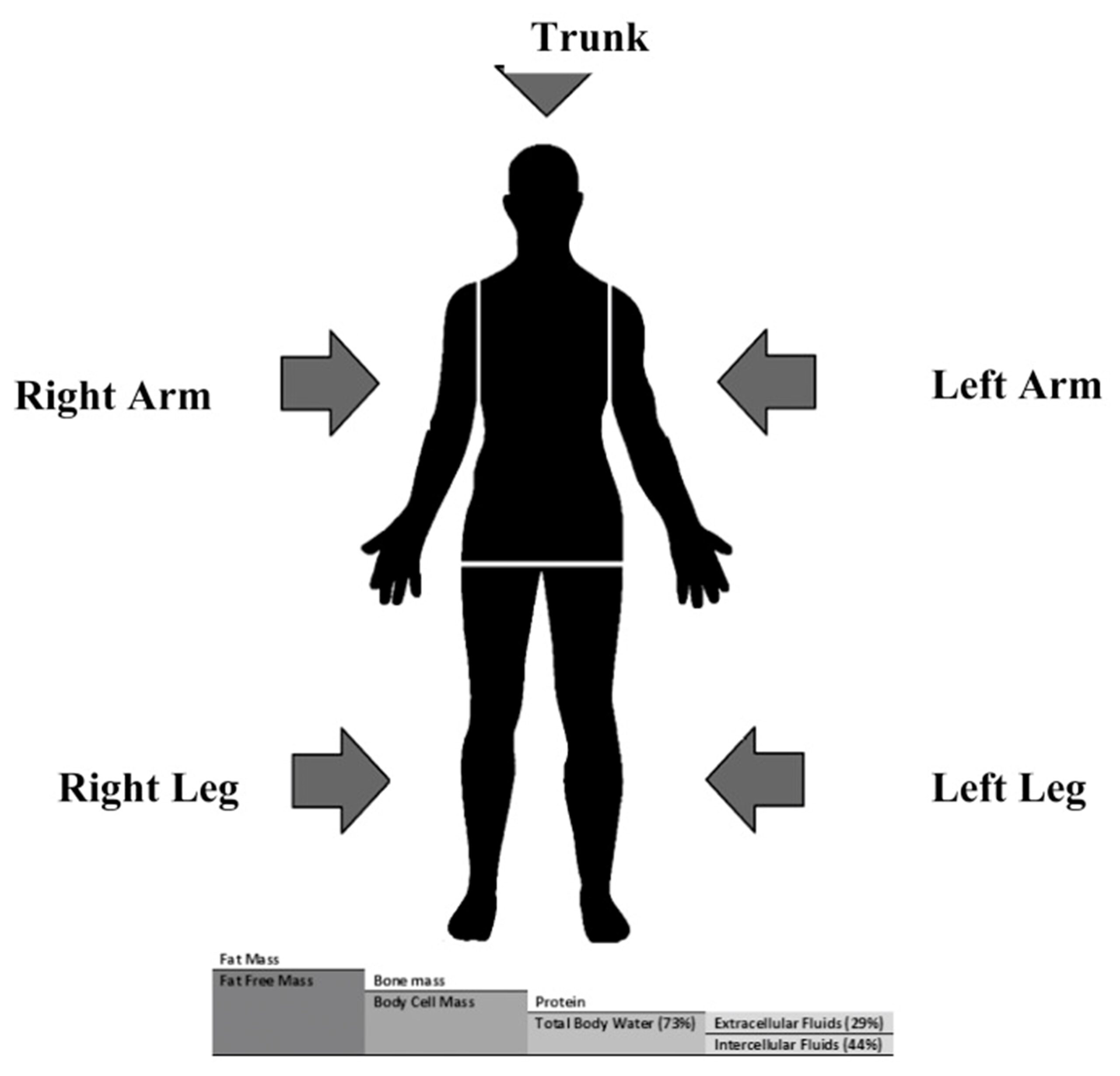
Image source: The Theory and Fundamentals of Bioimpedance Analysis in Clinical Status Monitoring and Diagnosis of Diseases – PMC (nih.gov)

Addressing obesity is another key use of BIA. Upper body (hand-to-hand) BIA is useful for estimating visceral and abdominal fat and small form-factor wearable devices such as a wristwatch can provide this data.  In contrast, lower body (leg-to-leg) BIA is useful for estimation of subcutaneous fat and is often obtained from a scale while acquiring weight information.

Different frequencies and multiple frequencies are among BIA aspects that are being explored for and implemented in clinical class products. Measurements at very low frequencies (in the range 1 to 5 kHz) have issues with cell membranes. In contrast, as the frequency increases, the phase angle and capacitive resistance (reactance) increase up to a maximum frequency of about 50 kHz. The use of multi-frequency analysis provides an improved differentiation for some metrics.

ImpediMed pioneered the use of bioimpedance spectroscopy (BIS) technology, one type of BIA, and produced the first commercially available BIS devices in 1990. Their patented technology measures impedance at 256 different frequencies, from 3 kHz to 1000 kHz and uses validated mathematical models to determine three pure resistance values in the body.

As noted in part 1, electrodes are one of the key portions of BIA measurements. The electrodes consist of two current-driving and two voltage-sensing electrodes. Most commercial BIA devices utilize large (4 × 1400 mm2) electrodes to counteract the effect of contact resistance that can cause measurement errors. Researchers have compensated for contact resistance by performing 4-point and 2-point measurements using 68 mm2 outer electrodes and 128 mm2 inner electrodes.

References for further reading:

[1] https://www.mdpi.com/1424-8220/21/9/3013/pdf

[2] Bioimpedance Devices Market is Projected to Reach Total Valuation of US$ 715.1 Million by 2028 – PharmiWeb.com

[3] https://www.bioscan.com/dtr_bioscan_bia.html

[4] https://www.impedimed.com/resources/bis-technology/

[5] https://www.nature.com/articles/s41598-020-79667-3
You may also like:


  • What metrics can bioelectrical impedance analysis provide? Pt 1.

Filed Under: Biometrics, Featured, Frequently Asked Question (FAQ) Tagged With: impedimed

Reader Interactions

Leave a Reply

You must be logged in to post a comment.

Primary Sidebar

Featured Contributions

Automotive sensor requirements for software-defined vehicles: latency, resolution, and zonal architecture

High-current, low-impedance systems need advanced current sensing technology

A2L refrigerants drive thermal drift concerns in HVAC systems

Integrating MEMS technology into next-gen vehicle safety features

Fire prevention through the Internet

More Featured Contributions

EE TECH TOOLBOX

“ee
Tech Toolbox: Power Efficiency
Discover proven strategies for power conversion, wide bandgap devices, and motor control — balancing performance, cost, and sustainability across industrial, automotive, and IoT systems.

EE LEARNING CENTER

EE Learning Center
“sensor
EXPAND YOUR KNOWLEDGE AND STAY CONNECTED
Get the latest info on technologies, tools and strategies for EE professionals.

RSS Current EDABoard.com discussions

RSS Current Electro-Tech-Online.com Discussions

  • WTB: "The Theory Of Servicing AM, FM, And FM Receivers" by Clarence R. Green and Robert M. Bourque
  • Anyone In The US Ordered From AliExpress Recently?
  • Calculation of A Class amplifier
  • strange laptop problem
  • restarting this Christmas project

EE ENGINEERING TRAINING DAYS

engineering
“bills

RSS Featured White Papers

  • 4D Imaging Radar: Sensor Supremacy For Sustained L2+ Vehicle Enablement
  • Amphenol RF solutions enable the RF & video signal chains in industrial robots
  • Implementing Position Sensors for Hazardous Areas & Safety

Footer

EE WORLD ONLINE NETWORK

  • 5G Technology World
  • EE World Online
  • Engineers Garage
  • Analog IC Tips
  • Battery Power Tips
  • Connector Tips
  • EDA Board Forums
  • Electro Tech Online Forums
  • EV Engineering
  • Microcontroller Tips
  • Power Electronic Tips
  • Test and Measurement Tips

SENSOR TIPS

  • Subscribe to our newsletter
  • Advertise with us
  • Contact us
  • About us

Copyright © 2025 · WTWH Media LLC and its licensors. All rights reserved.
The material on this site may not be reproduced, distributed, transmitted, cached or otherwise used, except with the prior written permission of WTWH Media.

Privacy Policy
