
• Skip to primary navigation
  • Skip to main content
  • Skip to primary sidebar
  • Skip to footer
  • Subscribe
  • Advertise

Sensor Tips

Sensor Product News, Tips, and learning resources for the Design Engineering Professional.

  • Motion Sensing
  • Vision systems
    • Smart cameras
    • Vision software
    • Lighting
    • Optics
  • Pressure
  • Speed
  • Temperature
  • Suppliers
  • Video
    • EE Videos
    • Teardown Videos
  • EE Learning Center
    • Design Guides
    • Tech Toolboxes

What sensors allow robots to work collaboratively and safely with humans?

December 2, 2020 By Randy Frank Leave a Comment

If advanced factories strictly concentrate on the machinery without taking human beings into account, will the robots have to consume the products they build? When Henry Ford installed the first moving assembly line to mass produce an entire automobile (Dec. 1, 1913), he more than doubled the wages of assembly line workers to stabilize his workforce. With these wages, Ford Motor Company workers could also become customers.

Keeping humans involved safely, while being at the center of a sophisticated production system, surrounded by machinery was the goal of Comau’s Advanced Use Robotic Arm or AURA robot design. In the Human-centered Manufacturing System (HuManS) project, this goal was achieved. To have humans work cooperatively with robots safely, involved the collaboration of FPT Industrial, Comau and another 17 other companies.

Standing almost three meters high and weighing about three tons, the AURA industrial robot can work alongside humans, without barriers and in the same work station. The robot helps the human operator and performs the most tiring and repetitive tasks, the hallmark of assembly lines since 1913. When necessary, the robot is manually guided by the human operator.
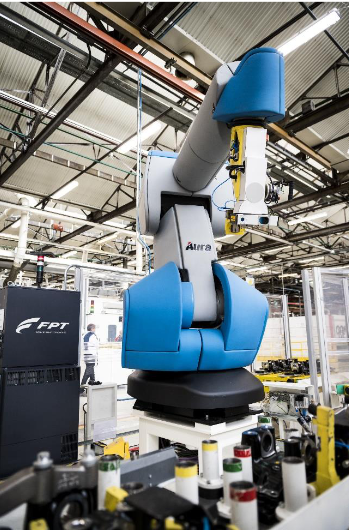
Safely working in the same confined workspace requires the AURA robot to be able to detect and properly react to the presence of other machinery or a real person. Four sensors help solve this challenge.

Soft, sensitive skin inspired by human skin allows the robot to decide whether to reduce its speed or stop entirely. A 3D camera allows the robot uses to scan and recognize the position of the work piece. Touch sensors in the gripper, make the robot capable of lifting the component with a firm but delicate grip. Finally, to work alongside a human on the FPT Industrial driveline assembly line without any barriers, AURA uses an advanced and complex laser scanning system to scan and monitor the work space when the arm is in operation.

The result of the collaboration is a robotic arm capable of lifting and moving up to 170 kilograms (375 pounds) with a human handling the delicate assembly stage.

Filed Under: Featured, Frequently Asked Question (FAQ), Image sensing, Smart cameras, Vision systems Tagged With: comau

Reader Interactions

Leave a Reply

You must be logged in to post a comment.

Primary Sidebar

Featured Contributions

Automotive sensor requirements for software-defined vehicles: latency, resolution, and zonal architecture

High-current, low-impedance systems need advanced current sensing technology

A2L refrigerants drive thermal drift concerns in HVAC systems

Integrating MEMS technology into next-gen vehicle safety features

Fire prevention through the Internet

More Featured Contributions

EE TECH TOOLBOX

“ee
Tech Toolbox: Connectivity
AI and high-performance computing demand interconnects that can handle massive data throughput without bottlenecks. This Tech Toolbox explores the connector technologies enabling ML systems, from high-speed board-to-board and PCIe interfaces to in-package optical interconnects and twin-axial assemblies.

EE LEARNING CENTER

EE Learning Center
“sensor
EXPAND YOUR KNOWLEDGE AND STAY CONNECTED
Get the latest info on technologies, tools and strategies for EE professionals.

RSS Current EDABoard.com discussions

RSS Current Electro-Tech-Online.com Discussions

  • ANOTHER OLD PROJECT REDO
  • To buy or DIY?
  • Math problem
  • Software for plotting
  • Sine wave oscillator schematic please?

EE ENGINEERING TRAINING DAYS

engineering
“bills

RSS Featured White Papers

  • 4D Imaging Radar: Sensor Supremacy For Sustained L2+ Vehicle Enablement
  • Amphenol RF solutions enable the RF & video signal chains in industrial robots
  • Implementing Position Sensors for Hazardous Areas & Safety

Footer

EE WORLD ONLINE NETWORK

  • 5G Technology World
  • EE World Online
  • Engineers Garage
  • Analog IC Tips
  • Battery Power Tips
  • Connector Tips
  • EDA Board Forums
  • Electro Tech Online Forums
  • EV Engineering
  • Microcontroller Tips
  • Power Electronic Tips
  • Test and Measurement Tips

SENSOR TIPS

  • Subscribe to our newsletter
  • Advertise with us
  • Contact us
  • About us

Copyright © 2026 · WTWH Media LLC and its licensors. All rights reserved.
The material on this site may not be reproduced, distributed, transmitted, cached or otherwise used, except with the prior written permission of WTWH Media.

Privacy Policy