 Silicon Designs, Inc. announced the global market launch of its Model 1525 Low-G Series of MEMS DC accelerometer chips, with stock quantities now available for immediate customer shipment.
The Silicon Designs Model 1525 Low-G Series is designed to offer reliable, accurate, and repeatable low-frequency (including seismic) vibration and acceleration measurements within a variety of inertial- and industrial-grade applications, and particularly so, where high-repeatability, premium performance, ultra-low noise, and maximum stability are required.
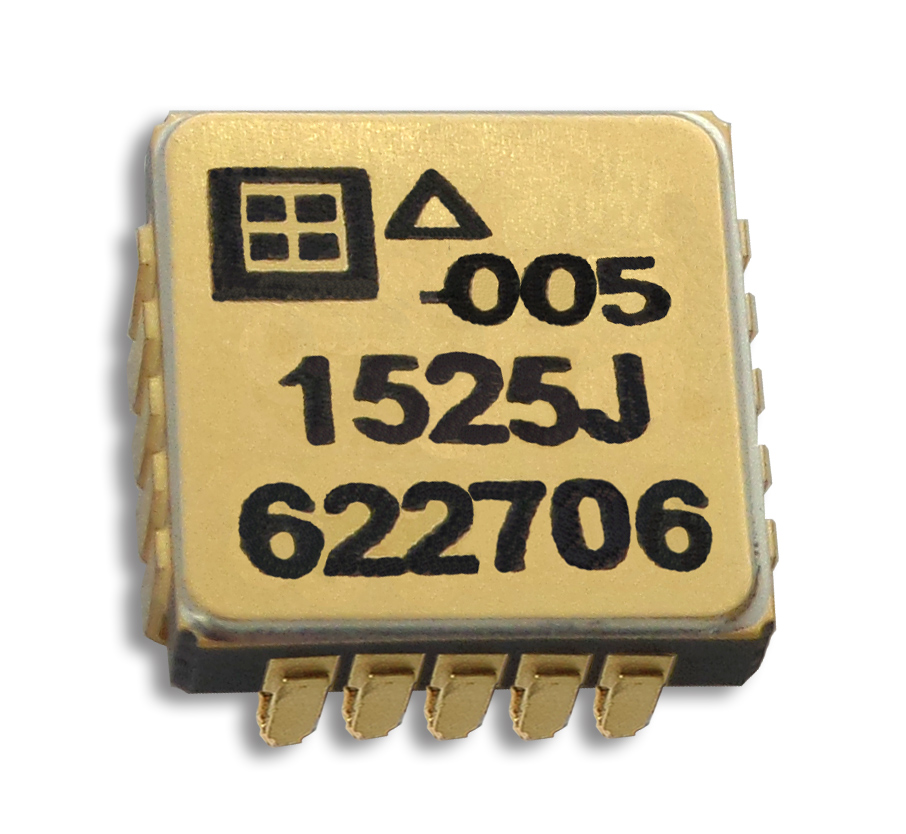
The key distinguishing features of the Model 1525 Low-G Series, among comparable industry models, include its highly favorable price-for-performance ratio, excellent in-run bias stability, zero cross-coupling by design, and Allan Variances from 5 µg. With availability in five unique full-scale ranges, each MEMS DC accelerometer chip within the Model 1525 Low-G Series incorporates one of Silicon Designs’ own high-performance sense elements, together with a ±4.0V differential analog output stage, internal temperature sensor, and integral sense amplifier. The MEMS DC sense element and internal components of the Model 1525 Low-G Series are housed together within a hermetically sealed, Nitrogen damped, 20-pin JLCC surface mount package (U.S. Export Classification ECCN 7A994) which measures just 0.35 square inches.
Each Model 1525 Low-G Series MEMS DC accelerometer chip is designed to be relatively insensitive to wide temperature changes and gradients, including over its standard operating temperature range of -40° C to +85° C. Each device is further marked on its top and bottom surfaces with a serial number for traceability. A calibration test sheet is also supplied with each unit, showing the MEMS DC accelerometer chip’s measured bias, scale factor, linearity, operating current, and frequency response performance values.
Since 1983, Silicon Designs has been recognized as an industry expert in the design, development, and manufacture of highly rugged MEMS DC accelerometers and chips with integrated amplification. All products are designed, developed, and manufactured in-house at the company’s own state-of-the-art facility located just outside of Seattle, Washington. In addition, as the OEM of its own MEMS DC accelerometer chips and modules, including in-house wafer production, Silicon Designs can ensure that each accelerometer within a particular series is made to be virtually identical, thereby allowing for seamless performance upgrades. The company’s fully U.S.-based manufacturing operations, including with ISO9001:2015 certified quality management systems, further allow Silicon Designs to ensure that its products remain consistently high-quality, are easily customizable to customer exacting standards, and can be offered with some of the industry’s most competitive pricing and lead times.