
• Skip to primary navigation
  • Skip to main content
  • Skip to primary sidebar
  • Skip to footer
  • Subscribe
  • Advertise

Sensor Tips

Sensor Product News, Tips, and learning resources for the Design Engineering Professional.

  • Motion Sensing
  • Vision systems
    • Smart cameras
    • Vision software
    • Lighting
    • Optics
  • Pressure
  • Speed
  • Temperature
  • Suppliers
  • Video
    • EE Videos
    • Teardown Videos
  • EE Learning Center
    • Design Guides
    • Tech Toolboxes

What is the difference between variable reluctance and eddy current speed sensors?

May 19, 2021 By Randy Frank

Both variable reluctance (VR) and eddy current (EC) technologies provide contactless speed sensors based on interaction with a magnetic field.

A variable reluctance sensor can be thought of as an AC generator with an output voltage proportional to speed. With its self-generating electrical signal, a VR sensor does not require an external power supply. The sensor consists of a permanent magnet and a ferromagnetic pole piece surrounded by a coil of wire and generates an analog voltage output signal when a ferromagnetic material passes by the tip of the pole piece. Since the linear output is a frequency, an A/D converter is required to obtain a digital signal.

Variable reluctance sensors rely on the variation of the air gap and cannot measure the speed of a smooth body/surface. Where zero speed sensing is required, VR speed sensors have limitations since the signal reduces with lower speeds to a zero output a zero speed. However, amplified (active) VR sensors that integrate a preamplifier/signal conditioner within the sensor housing offer near-zero velocity (as low as 2 Hz) speed sensing and can tolerate larger air gaps.

Eddy current sensors are more commonly used for proximity or displacement measurements, but they can be used for speed sensing as well. There are both active and passive eddy current sensors.

In contrast to a VR speed sensor, the EC sensor just needs a conductive material for the target and not a magnetic material. Using the effect of eddy (circular) currents, the EC sensor senses the proximity of non-magnetic but conductive materials.

In an active, two-coil design, the active coil senses the presence of a nearby conductive object, and a balance coil nulls the output bridge circuit and is used for temperature compensation. The active coil is driven with a time varying excitation voltage in the 1 kHz to 1 MHz range.
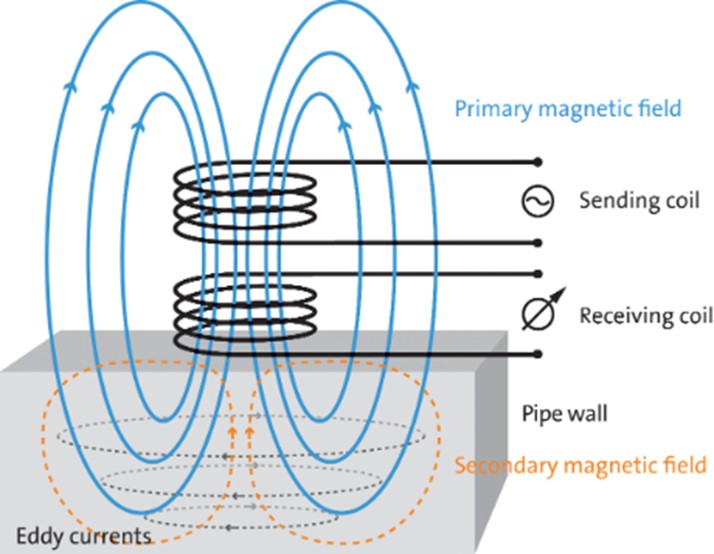
Image source ROSEN.

Similar to a VR sensor, passive eddy current sensors use permanent magnets, behave like small electrical generators, and do not require an external power source.

Eddy current sensors are often selected for applications with dirty environments because they have a high tolerance for dirt. They continue to work even if there is material between the probe and the target.

Filed Under: Featured, Frequently Asked Question (FAQ), Speed Tagged With: rosen

Primary Sidebar

Featured Contributions

Automotive sensor requirements for software-defined vehicles: latency, resolution, and zonal architecture

High-current, low-impedance systems need advanced current sensing technology

A2L refrigerants drive thermal drift concerns in HVAC systems

Integrating MEMS technology into next-gen vehicle safety features

Fire prevention through the Internet

More Featured Contributions

EE TECH TOOLBOX

“ee
Tech Toolbox: Connectivity
AI and high-performance computing demand interconnects that can handle massive data throughput without bottlenecks. This Tech Toolbox explores the connector technologies enabling ML systems, from high-speed board-to-board and PCIe interfaces to in-package optical interconnects and twin-axial assemblies.

EE LEARNING CENTER

EE Learning Center
“sensor
EXPAND YOUR KNOWLEDGE AND STAY CONNECTED
Get the latest info on technologies, tools and strategies for EE professionals.

RSS Current EDABoard.com discussions

RSS Current Electro-Tech-Online.com Discussions

  • updating circuit with power on off switching
  • potenciometer attachment / screwdriver
  • Steering angle sensor question
  • flexible copper cable
  • factory device from 2017'ish with web ui - too old to function with Microsoft Edge ?

EE ENGINEERING TRAINING DAYS

engineering
“bills

RSS Featured White Papers

  • 4D Imaging Radar: Sensor Supremacy For Sustained L2+ Vehicle Enablement
  • Amphenol RF solutions enable the RF & video signal chains in industrial robots
  • Implementing Position Sensors for Hazardous Areas & Safety

Footer

EE WORLD ONLINE NETWORK

  • 5G Technology World
  • EE World Online
  • Engineers Garage
  • Analog IC Tips
  • Battery Power Tips
  • Connector Tips
  • EDA Board Forums
  • Electro Tech Online Forums
  • EV Engineering
  • Microcontroller Tips
  • Power Electronic Tips
  • Test and Measurement Tips

SENSOR TIPS

  • Subscribe to our newsletter
  • Advertise with us
  • Contact us
  • About us

Copyright © 2026 · WTWH Media LLC and its licensors. All rights reserved.
The material on this site may not be reproduced, distributed, transmitted, cached or otherwise used, except with the prior written permission of WTWH Media.

Privacy Policy