This versatile temperature sensor is one of many viable alternatives.
Temperature is the most widely sensed real-world parameter, and knowing the temperature with some combination of accuracy, precision, and repeatability is critical in many applications. A widely used choice for the temperature sensor is the resistance temperature detector (RTD), a precision metal element usually made of pure or nearly pure platinum. The platinum-based sensor has a fully detailed, repeatable, and characterized resistance-versus-temperature transfer function.
The RTD is just one of many sensors used for the measurement of temperature. Depending on the needed range, accuracy, resolution, ruggedness, application constraints, cost, size, and other considerations, it competes with thermistors, solid-state sensors, non-contact IR measurement, and even some esoteric approaches.
To fully realize the performance potential of this two-terminal sensor, the designer must understand the various ways of driving it and measuring its resistance to determine temperature. Further, many applications require multiple RTDs, so the interface approach and associated circuitry must accommodate this scenario as well.
This article shows RTD-specific components address and overcome the RTD’s inherent idiosyncrasies, which are unavoidable and which can otherwise make it difficult to use or achieve its full performance potential.
The RTD as sensor
Somewhat similar to the thermistor, the operating principle of the RTD is deceptively simple. It is a platinum wire or thin film, sometimes with other precious metals added, such as rhodium, with a known nominal resistance and a positive change in resistance as a function of temperature (positive temperature coefficient). RTDs can be fabricated with many different nominal resistance values, and the most common are the Pt100and Pt1000 (sometimes written as PT100 and PT1000) with nominal resistance of 100 ohms and 1000 ohms, respectively, at 0⁰C.

Common ways of constructing the sensor include winding the platinum wire around a glass or ceramic support or using platinum in a thin-film fabrication, as shown in Figure 1. Due to their widespread use and need for interchangeability, international standard DIN EN 60751 (2008) defines the detailed electrical characteristics of platinum temperature sensors. The standard contains tables of resistance versus temperature, tolerances, curves, and temperature ranges; there is an equivalent NIST standard Publication 250-81 (formerly National Bureau of Standards, or NBS).
Standard platinum RTDs operate over the range of -200⁰C to +800⁰C. Their key attributes include high stability, repeatability, and accuracy. These virtues are achievable if they are properly driven by a current or voltage source, and their resistance is measured as a voltage across their two terminals using a suitable analog front-end (AFE) circuit, with the voltage readings linearized for highest accuracy.
The RTD’s resistance changes fairly dramatically with temperature, a characteristic that adds to its suitability for high-precision measurement. For a standard Pt100 device, the resistance changes from about 25 ohms at -200⁰C to about +375 ohms at +800⁰C. The average slope between 0°C and +100°C is called alpha (α), and its value depends on the impurities and their concentrations in the platinum. The two most widely used values for alpha are 0.00385055 and 0.00392.
RTD linearization
RTDs have a curved, monotonic deviation from straight-line transfer-function linearity. For applications needing accuracy to one or a few degrees, it may not be necessary to linearize the transfer function, since the deviation is fairly small, as seen in Figure 2. For example, between -20⁰C and +120⁰C, the difference is less than ±0.4⁰C.

However, the RTD is often used in precision applications needing accuracy to a tenth or better of a degree, and so linearization is needed. Linearization can be implemented by computation in software or by a look-up table. For highly accurate linearization, the Callendar-Van Dusen equation is used:
R(T) = R0(1 + aT + bT2 + c(T – 100)T3)
where T = temperature (°C); R(T) = resistance at T; R0 = resistance at T = 0°C.
For α = 0.00385055, the DIN RTD standard defines the Callendar-Van Dusen coefficient values a, b, and c as:
a = 3.90830 x 10⁻³,
b = -5.77500 x 10⁻⁷, and
c = -4.18301 x 10⁻¹² from -200°C to 0°C, and c = 0 from 0°C to +850°C
This has the benefit of reducing the polynomial to a simpler, second-order equation.
RTD connections
As A passive, two-terminal resistor, the RTD interface drive and sensing circuits are simple in principle, and this drive can be a voltage or current source. In the most basic form with a voltage source, the RTD leads are connected to the source along with a stable, known resistor in series, usually with the same nominal value, in a standard voltage-divider scheme, and the voltage across both are measured; simple voltage-divider calculations are then used to calculate the RTD resistance, shown in Figure 3. Accuracy can be improved by measuring the voltage across the known resistor along with the voltage across the RTD.
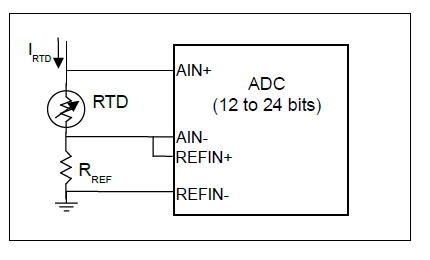
While simple, this arrangement has many sources of potential inaccuracy, including changes in the source voltage, reference-resistor temperature coefficient, connection-lead IR drop, and even the temperature coefficient of the copper connection leads, which is about +0.4 percent per degree C. To partially overcome these error sources, the RTD is often instead used in a ratiometric Wheatstone-bridge configuration, which cancels out these errors to some extent.
However, the bridge and voltage-drive approach still has weaknesses. A ratiometric arrangement, such as the bridge, has a well-known nonlinear relationship of its own, independent of the nonlinearity of any bridge element itself. Therefore, this relationship must be factored into the calculations, which correct for the nonlinearity of the RTD element, which complicates the algorithm and adds to the processing load.
For these and other reasons, the RTD is almost always used with a current source. This allows full control over the RTC drive and also offers opportunities to more directly compensate for voltage drop and temperature-related changes in the connection leads. Depending on the application and distance between the RTD and its analog front end (AFE), designers can use 2-, 3-, 4-, or 4-wire with loop connections of Figure 4.

The 2-wire connection is the simplest, least bulky, and least costly. However, it is suitable for accurate results only when the wires connecting the Pt100 RTD to the AFE circuit have a very low resistance of under a few milliohms, so the wire resistance does not become significant compared to the RTD resistance.
Typically, this restricts the distance to about 25 centimeters, but it is also a function of the gauge of those wires, which tend to be thin gauge due to the physical installation configuration and constraints. It is possible, of course, to correct for the voltage drop using calculations, but this adds to complexity, especially if the lead wire resistance is affected by temperature.
For longer distances up to about 30 meters, the 3-wire approach is used. Here, the circuit monitors one side of the current loop with a Kelvin connection, measuring voltage drop in the resistance of the loop and then compensating for that drop. This method assumes the voltage drop in the non-Kelvin lead is the same as in the Kelvin-lead side.
The 4-wire approach uses full Kelvin sensing to monitor both sides of the current loop of the RTD. This approach offers precision in eliminating the effect of lead resistance, regardless of differences between the two current-source wires. It can be used for hundreds of meters but has the highest material and wire-bulk impact.
Note that the choice of using a 2-, 3-, or 4-wire interface is independent of the RTD, and any RTD can be used with any of the choices, provided there is space and access to make the needed physical connections. However, in physically small set-ups, the mass of the wire bundle may introduce thermal shifts and additional thermal time constants. In general, it’s good practice to keep the thermal mass of the sensing arrangement as small as possible relative to the mass being sensed.
Issues related to the connection leads and signal integrity go beyond just basic DC resistance. Noise is often a concern, and even though temperature is a relatively slow-changing phenomenon compared to most noise signs, noise can still corrupt the signal at the AFE if it occurs just as the voltage across the RTD is being sampled or converted. In extreme cases, noise can saturate the front end and “blind it” for a millisecond until the front end comes out of saturation.
For this and other reasons, the sense leads from the RTD should be balanced (sometimes called longitudinal balance) with equal impedance to ground if their length is greater than about one meter. The reason is that these parallel leads will likely have a common-mode voltage (CMV) and noise, but the differential front end of the AFE can reject these. However, if the leads are unbalanced, the circuit will convert some of the common-mode signal to an unbalanced signal, which will not be rejected by the differential input of the AFE.
Pt100 vs Pt1000 RTD choice
Since the most common RTDs are available with either 100-ohm or 1000-ohm resistance at 0⁰C, the obvious question is how to choose between them. As always, there are tradeoffs and no single “right” answer, as it depends on the application specifics. Note that the linearity of the characteristic curve, operating temperature range, and response time are the same or nearly so for both Pt100 and Pt1000 RTDs, and their temperature coefficient of resistance is also the same.
The Pt100 RTD has lower nominal resistance, of course, and therefore, as noted earlier, it can only be used for short distances in a 2-wire configuration, as lead resistance will be significant compared to the RTD itself. In contrast, the lead resistance is a much smaller fraction relative to the Pt1000 resistance, so the Pt1000 is better suited to longer two-wire runs.
Since the Pt1000 RTD has higher resistance, it requires less drive current to develop a given voltage across it, according to basic Ohm’s law, V = IR. A modest one milliampere (mA) current will yield a one-volt drop at 0⁰C, and the voltage increases from that value as temperature increases.
However, there is a potential undesired consequence of higher voltages, as the RTD voltage may overrange the AFE front end at higher temperatures. Also, the current source needs to have sufficient compliance to drive the fixed current value through the resistance. For example, 1 mA through 1000 ohms requires a current-source compliance of a little above 1 V, but as the RTD heats up and its resistance increases, the compliance needed increases proportionally. Thus, a high-resistance RTD current source may require higher-voltage rails to ensure adequate compliance voltage.
The lower current needed by the PT1000 for a given voltage drop brings two benefits. First, less power is needed, which increases battery life for remote installations. Second, self-heating of the RTD is reduced, and this self-heating can have a major effect on the accuracy of the reading. Proper engineering practice is to use a current drive level that minimizes sensor self-heating, consistent with developing sufficient voltage drop and thus resolution across the RTD.
This does not mean that there is little place for Pt100 RTDs. In fact, they are widely used in industry due to legacy reasons, and where lead length, low-power operation, and self-heating are not major factors. As low-impedance loops, Pt100 RTD installations are also much less sensitive to noise pickup compared to those with the Pt1000 RTD, which inherently has a loop impedance that is ten times higher.
There are also mechanical considerations in addition to the electric ones. Pt100 sensors are available as both wire-wound and thin-film constructions with different physical attributes, while Pt1000 RTDs are generally offered only as thin-film devices.
The next part looks at ICs that are used for RTD interfacing.
References
What is the Difference Between a 2, 3, and 4 Wire RTD?, Omega Engineering
How to Choose Between a RTD Pt100 vs Pt1000?, Omega Engineering
RTD vs Thermocouples, Omega Engineering
Temperature probes, Omega Engineering
Operating limits and tolerances of platinum resistance thermometers per EN 60751: 2008, WIKA Alexander Wiegand SE & Co. KG
Pt100 and Pt1000 Sensors: Important Facts and Differences, WIKA Alexander Wiegand SE & Co. KG
Standard Platinum Resistance Thermometer Calibrations from the ArTP to the Ag FP, NIST Special Publication 250-81
Thin-Film Resistance Thermometers on Silicon Wafers, NIST
Thermal Management Handbook, Analog Devices/Maxim Integrated
Practical RTD Interface Solutions, Texas Instruments, SNOA481B
A Basic Guide to RTD Measurements, Texas Instruments, SBAA275
OPAx317 Zero-Drift, Low-Offset, Rail-to-Rail I/O Operational Amplifier, Texas Instruments
Precision RTD Instrumentation for Temperature Sensing, Microchip Technology
Related EE World content
What’s the difference between 2-, 3-, & 4-wire RDT sensing?
Temperature Sensors: thermocouple vs. RTD vs. thermistor vs. semiconductor IC
20-mA current loops, Part 1: Basic functions
20 mA current loops, Part 2: Advanced features
How does a thermocouple work, and do I really need an ice bath? part 1
How does a thermocouple work, and do I really need an ice bath? part 2
Temperature sensors: IoT tilts balance from traditional devices to chips
The hot wire anemometer, Part 1: Principles
The hot wire anemometer, Part 2: Implementation
The hot and cold of thermocouples
FAQ on thermistors for temperature sensing

Leave a Reply
You must be logged in to post a comment.