Cryogenic temperatures may seem only of limited interest, but they are actually critical in many instrumentation and other systems. Measuring these ultralow temperatures is both easy and difficult, depending on temperature, material, and mass.
Temperature is the most commonly measured physical variable, whether it’s just to assess the local weather to manage the performance of electronic systems. Although much of our day-to-day experience is centered between 0°C (32°F) and +100°C (212°F), the electronics range of interest -40°C (coincidentally, also -40°F) to +125°C or perhaps even +150°C (257°F/302°F). Still, there is tremendous interest and need to measure temperatures outside that core range, in both high and low directions (Figure 1).
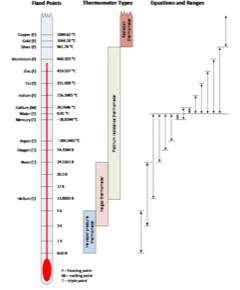
This article will look at sensors for measuring ultracold temperatures below -40°C and even cryogenic temperatures close to 0 K (–273.15°C or –459.67°F), commonly referred to as “absolute zero.” It will look at how temperatures are measured at these ultracold and even cryogenic ranges. Note that it is easier to heat substantial quantities of a substance or material to high and even higher temperatures than it is to cool or supercool even modest or tiny samples.
Q: What do we mean by cryogenic temperatures?
A: While there is no “official” definition, the U.S. National Institute of Standards and Technology (NIST) considers cryogenics as temperatures below -180°C (93 K; -292°F). Many researchers consider a gas to be cryogenic if it can be liquefied at or below -150 °C (123 K; -238 °F). The degree is an increment of temperature, assigned as a fixed fraction of the distance between two defined reference points on a temperature scale.
Q: Why that temperature?
A: It is a logical dividing line since the normal boiling points of the so-called permanent gases (including helium, hydrogen, neon, nitrogen, oxygen, and even “normal” air) are below −180°C while the Freon refrigerants, hydrocarbons, and other common refrigerants have boiling points above −180°C (that is one of their useful characteristics).
Q: Why do we even care about these low temperatures, except for in highly specialized or R&D applications, when most of conventional activity s in that mid-range of -40°C to +125°C?
A: First, liquified gases such as oxygen, hydrogen, and helium are used in applications such as cooling superconducting magnets, minimizing the internal noise of the low-noise front-end amplifiers (LNAs) of a deep-space antenna, many specialized scientific instruments, or powering liquid-fueled rockets. Second, there’s an amazing amount of research being done at these temperatures, as both basic physics investigations as well as material-related applications (just go to the annual meeting the Material Research Society and you’ll see dramatic proof).
Q: This all still seems removed from day-to-day engineering activities — is it?
A: Although it may seem that this is still esoteric research – and admittedly, much of it is – and thus irrelevant to most engineering, the history of science and engineering advances shows that it is impossible to foresee where such theoretical discoveries will lead. After all, the “who cared” about discovery of the magnetic moment of atomic nuclei, other than a few atomic physicists? Yet that discovery eventually became the basis for the widely used MRI system, although the physics research was not done with any even remotely related to an imaging end-application in mind (References 1 and 2).
Q: So, how do you begin to go about measuring these temperatures?
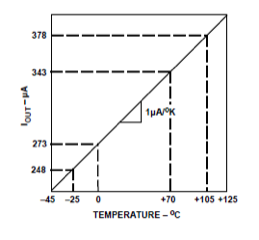
A: Start with the easier mid-range. Most general application temperature measurements occur within a fairly limited range between water freezing and boiling (0°C to 100°C), although there are certainly many situations which extend beyond both these levels. Fortunately, low-cost, easy-to-use solid-state sensors such as the are available which are specified for various ranges (Figure 2), and special ones are available with a wider range. Further, long-used sensors such as thermocouples, resistance temperature detectors (RTDs), and even thermistors can handle much wider ranges, going down to about -200°C than the solid-state sensors.
Q: Does this mean that measuring to -200°C is “routine?”
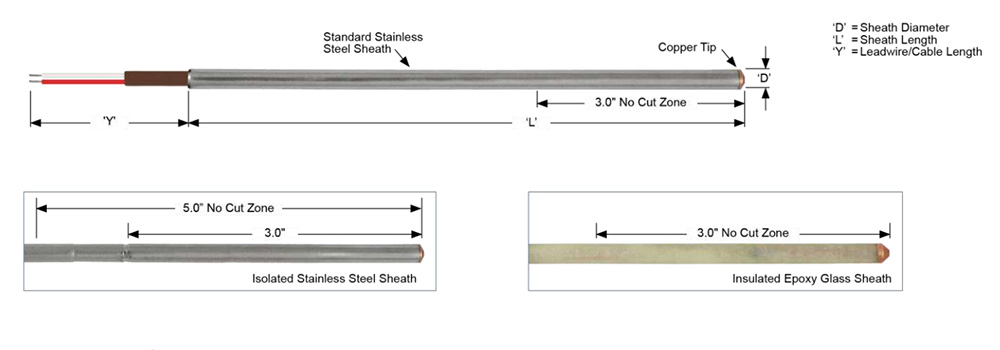
A: Yes and know. For example, the TE Connectivity Measurement Specialties R-10318-69 Type-T thermocouple covers the wider -200°C (73 K) to +350°C (623 K) range. Generally, finding a sensor for these measurements is not the problem. Instead, the challenges are in applying the sensor in a way that it reports accurately; does not impact the item or material under test; and the probe, its insulation, and connections can function despite the extremes of the range (Figure 3).
Part 1 began a discussion of ultracold and cryogenic temperature sensors and measurement. Part 2 continues the investigation.
References
- EE World Online, “Magnetic resonance imaging (MRI), Part 1: How it works”
- EE World Online, “MRI, Part 2: Historical development (and lawsuits)”
- IEEE Spectrum, “Quantum Computing: Atomic Clocks Make for Longer-Lasting Qubits“
- Measurement Standards Laboratory of New Zealand, “Kelvin”
- National Institute of Standards and Technology (NIST), “The International Temperature Scale of 1990”
- National Institute of Standards and Technology (NIST), “Kelvin: ITS-90”