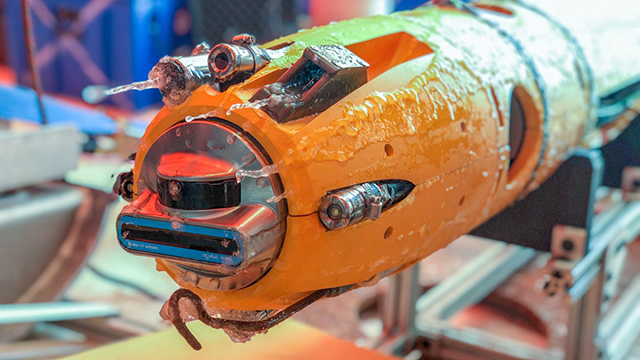
Obviously, different design requirements exist depending on the targeted applications, but autonomous or remotely piloted drones also dictate different criteria. One of the more unique underwater applications involved undersea (in the ice) measurements in Antarctica. The intent of the expedition was to gather sufficient, highly accurate information to improve modeling of ice shelf melting and freezing rates at grounding zones. With this information, researchers could determine the potential contribution of crevasses in the ice to the global sea-level rise.
Ocean conditions near where an ice shelf meets the coastline provide a critical juncture known as the grounding zone. Crevasses in the ice contribute to circulating seawater beneath Antarctic ice shelves and potentially influence their stability. A Cornell University-led research team wanted to know the extent. Project RISE UP (Ross Ice Shelf and Europa Underwater Probe), part of NASA’s Planetary Science and Technology from Analog Research program, provided the funding for an expedition. The National Science Foundation provided logistical support through the U.S. Antarctic Program.
To obtain the desired data, a remotely operated robot called Icefin was lowered down a hot water drilled borehole to the grounding zone. The 12-foot long and 10-inch-wide robot’s ascent and descent in the crevasse produced the first 3D measurements of a grounding zone. To do this, the robot was equipped with thrusters, cameras, sonar, and sensors for measuring water temperature, pressure and salinity. It climbed nearly 150 feet up one slope and descended the other to obtain the desired measurements.
By measuring the hydrographic properties of the water column and the ice and seafloor elevations, the conductivity-temperature (CT) and pressure sensors on the robot provided hydrographic conditions in close proximity to the ice surface along each crevasse sidewall. Video cameras provided visual images of the under-ice environment while a forward-looking sonar was used to measure the range from a surface and the dimensions of unique features present on that surface.
Since the goal was to obtain highly accurate readings, the conductivity-temperature sensor had manufacturer-stated accuracies of C: ± 0.010 mS cm−1, and T: ± 0.005°C, and the pressure sensor had P: 0.100 dbar. These C, T, and P accuracies translate to uncertainties in SA of ±0.008 g kg−1 and Θ of ±0.018°C. All sensors were factory-calibrated before the expedition, and the CT sensor was field-calibrated during the expedition.
NASA expects that robots like Icefin will be able to explore the ice-covered ocean on Jupiter’s moon, Europa.
Ongoing undersea monitoring
The need to monitor critical underwater structures received additional incentives after the 2022 Nord Stream gas pipeline attack in the Baltic Sea. With growing awareness of the value and vulnerability of sub-sea infrastructures, the use of underwater drones designed to protect cables and pipelines is expected to increase. In Europe, the European Union’s Permanent Structured Cooperation, known as PESCO, recently announced commitments undertaken by 26 Member States to improve sub-sea security for energy pipelines and internet cables.
PESCO members are already discussing with industry future cooperation to protect the future mining of rare earths and lithium on the seabed of the Mediterranean. These minerals are key to manufacturing microchips and batteries for electric vehicles and today’s sources are very limited. Information about specific sensors and cameras is not available yet.
References
https://www.science.org/doi/full/10.1126/sciadv.adi7638
Image source: https://sustainability.cornell.edu/assets/images/content/features/0302_icefin_0.jpg