Zonal sensor redundancy begins with a structural shift in vehicle wiring. The industry is moving from function-based networks to geometry-based ones. That single change ripples through sensor placement, latency, and fault tolerance. This article examines how zonal architectures relocate sensors, consolidate the wiring harness, affect communication latency, and reshape fail-operational redundancy. How does zonal design […]
EV Engineering
Combined sensing simplifies electric vehicle thermal management
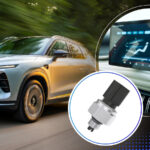
Sensata Technologies has introduced its R290 Pressure + Temperature (P+T) Sensor for electric vehicle thermal management systems using R290 (propane) refrigerant. The sensor combines pressure and temperature measurement in one device, with a leakage-optimized design and construction intended for automotive operating conditions. It supports air-conditioning and thermal management systems in battery electric vehicles, plug-in hybrid […]
How sensor placement and density impact thermal mapping in EV battery packs
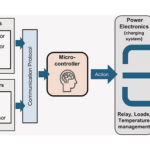
Temperature sensors in electric vehicle (EV) battery packs measure temperature only where they are mounted. Nevertheless, a battery management system (BMS) must use limited local readings to reconstruct the pack temperature field, detect developing hot spots, and drive cooling decisions that reflect cell-level conditions. This article reviews how sensor placement and density affect BMS monitoring […]
Dual-axis current sensor cuts displacement error in EV inverters

Texas Instruments (TI) has introduced the TMCS2100-Q1, a multiaxial coreless Hall-effect current sensor for HEV and EV traction inverters. The device measures magnetic fields on horizontal and vertical axes and is specified for displacement error below 1% at 0.4 mm movement and as low as 0.25% at 0.1 mm, which supports tighter inverter current control […]
Increased voltage levels and faster switching speeds influence on sensor placement and accuracy in EV systems
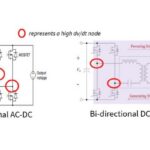
The advancements in the EV industry, such as WBG devices and 800 V systems, introduce specific technical challenges for sensor accuracy and physical placement. Higher operational voltages require more robust electromagnetic interference (EMI) filtering, while faster switching speeds generate high dv/dt and di/dt noise. This FAQ examines how these factors affect sensing integrity and provides […]
Integrating MEMS technology into next-gen vehicle safety features

Sensor technology has revolutionized the automotive sector, enabling significant advancements in safety, comfort, and automation. Today, vehicles have systems that leverage precise sensing capabilities to enhance the driver and passenger experience while reducing road risks. MEMS (Micro-Electrical Mechanical Systems) technology is at the forefront of this innovation, providing the compactness, accuracy, and reliability required for […]
Beyond the drivetrain: sensor innovation in automotive

By Karsten Köhler, Business Development Manager at TDK-Micronas The auto industry is amid two transformative trends: the gradual transition from internal combustion engines (ICE) to electric motors and drivetrains and the ongoing development of driver assistance and self-driving features. Sensor technology is famously integral to both trends, but electrification and assisted driving account for only […]
Coreless current sensor achieves 2 μs response time for EV applications

Melexis unveils the MLX91235, a new current sensor that eliminates the need for a ferromagnetic core. The MLX91235 expands Melexis’ portfolio, enabling the measurement of larger currents flowing through external primary conductors like PCB traces and busbars. It supports automotive and alternative mobility applications like inverters, battery management systems (BMSs), and low-voltage DC-DC converters. Power […]
What are the types and uses of position and angle sensors in an EV?

Position and angle sensors are used in several electric vehicle (EV) components, including the traction motor and drivetrain, heating, ventilation, air-conditioning (HVAC) compressor, steer-by-wire, brake-by-wire, regenerative braking, accelerator position, active headlight aiming, active suspension systems, and more. This FAQ reviews some position and angle sensing technologies and how the use cases differ between internal combustion […]
How current sensing impacts electric vehicles: part 2
Part 1 of this blog addressed current shunts and Hall-effect sensor designs. This part discusses current transformers and new technology options, such as magnetoresistance and diamond quantum sensors. One of the significant issues in today’s electric vehicles (EVs) is the ongoing evolution of technology, with the standards evolving as well. In the 100+ years that […]
